The Gap Between AI Talk and AI Talent
In 2026, every company's investor deck mentions AI. Every quarterly earnings call includes the phrase "AI-powered." Every product marketing page has at least one reference to machine learning.
Job postings tell a different story. They tell you which companies are committing budget to AI capabilities, and which are just borrowing the vocabulary. The gap between the two is enormous.
By analyzing job posting data across thousands of companies, clear patterns emerge about where enterprise AI adoption stands, not where press releases claim it stands.
The Three Phases of Enterprise AI Hiring
Phase 1: The Exploration Hire (2022-2023)
Companies hired their first "data scientist" or "ML researcher." Often a lone wolf role, reporting to engineering or product. The job descriptions were vague: "apply ML to our data" without specifying what problem to solve. Many of these hires churned within 18 months because the company didn't have the infrastructure to support them.
Phase 2: The Infrastructure Build (2024-2025)
The smart companies figured out that ML models are useless without ML infrastructure. Postings shifted toward "ML Platform Engineer," "MLOps Engineer," and "Data Infrastructure Engineer." This was the unsexy but necessary phase: building the pipes before turning on the water.
Phase 3: The Production Push (2026-Present)
Now the postings are getting specific. "LLM Fine-Tuning Engineer." "AI Product Manager, Customer-Facing Features." "ML Engineer, Recommendation Systems." These aren't exploration hires. They're production hires with defined scope and measurable outcomes.
Where a company falls on this phase timeline tells you how far ahead or behind they are on AI. If they're still posting generalist "Data Scientist" roles with vague descriptions, they're in Phase 1. If they're posting for AI product managers, they've reached Phase 3.
What the Job Requirements Reveal
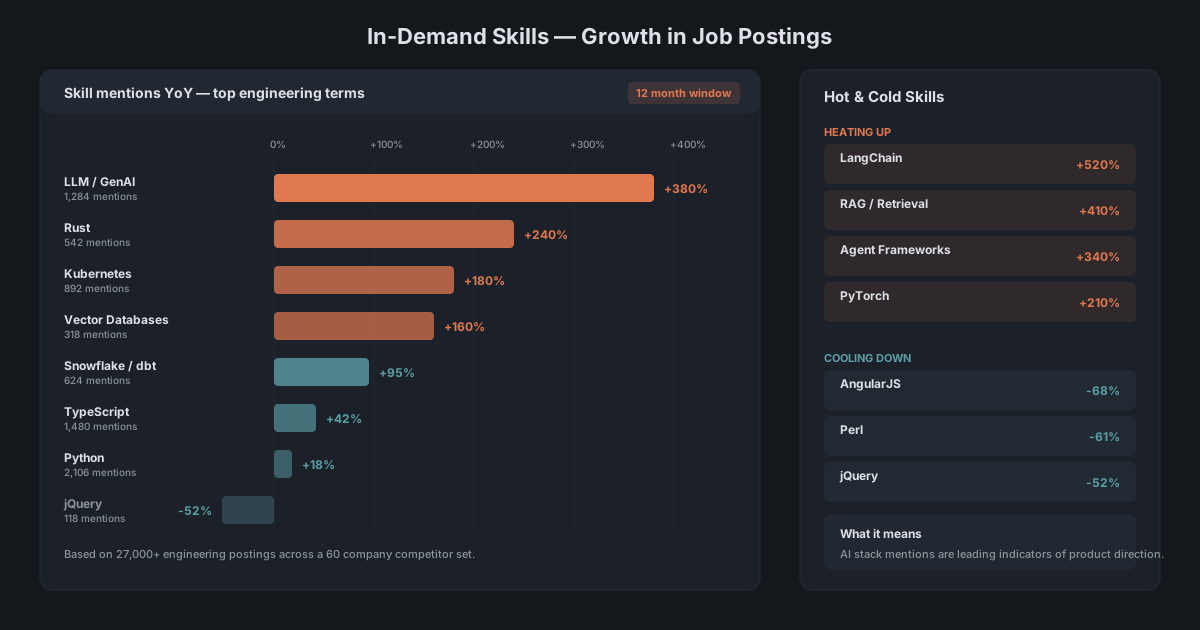
The specific technologies and skills listed in AI job postings track the market's evolution in real time.
Technologies Growing Fast in 2026 Postings
- LangChain, LlamaIndex, vector databases (Pinecone, Weaviate): RAG (retrieval-augmented generation) is the dominant architecture for enterprise LLM applications. Companies hiring for these skills are building AI features, not running experiments.
- Fine-tuning frameworks (LoRA, QLoRA, PEFT): Signals that companies are moving past generic foundation models to domain-specific ones. This is expensive and only worth doing if the use case is validated.
- ML monitoring tools (Arize, WhyLabs, Evidently): These appear when models are in production and need reliability. Seeing these in postings means the company is past experimentation.
- Edge AI frameworks (TensorRT, ONNX Runtime): On-device inference. Shows up in hardware, automotive, and IoT companies building real-time AI features.
Technologies Declining or Plateauing
- Generic "Python, SQL, Tableau" data science postings: These are being replaced by more specific AI engineering roles. The generalist data scientist is giving way to the specialist.
- Hadoop, Spark-only data infrastructure: Being replaced by modern stack (Snowflake/Databricks + dbt + Airflow). Companies still hiring for legacy data infra are behind.
Salary Data: The AI Premium Is Real but Narrowing
Job posting salary data from pay transparency states tells a clear story about AI compensation in 2026:
- Senior ML Engineer: $200K-$280K base at mid-to-large tech companies. Up ~8% from 2025.
- LLM/NLP Specialist: $220K-$320K base. The scarcity premium for LLM expertise remains significant.
- AI Product Manager: $180K-$250K base. A relatively new category commanding a 10-15% premium over general PM roles.
- ML Infrastructure/MLOps: $190K-$260K base. The unsung heroes of AI are finally getting paid like it.
- Junior ML Engineer / Data Scientist: $110K-$150K base. Flat or declining as the supply of entry-level AI talent grows faster than demand.
The bifurcation is the story. Specialist AI roles (LLM fine-tuning, ML infrastructure, AI safety) continue to command large premiums. Generalist ML roles are becoming commoditized as bootcamps and university programs flood the market with entry-level talent. The Bureau of Labor Statistics projects strong growth for AI-adjacent roles through 2030.
Industry Breakdowns: Who's Hiring and Who's Bluffing
Financial Services: The Biggest Spender
Banks and hedge funds have the largest AI hiring volumes, driven by fraud detection, algorithmic trading, and risk modeling. JPMorgan, Goldman Sachs, and Citadel consistently rank among the top AI employers. They pay the most and hire the most. If you're competing with financial services for AI talent, prepare to lose on comp.
Enterprise SaaS: The Fastest Mover
SaaS companies are integrating AI into their core products at a pace that exceeds every other sector. The postings are specific: "ML Engineer, Document Understanding" at a legal tech company, "AI Engineer, Revenue Forecasting" at a CRM company. These are product hires, not research hires.
Healthcare: Cautious but Growing
Healthcare AI hiring is constrained by regulatory requirements (HIPAA, FDA clearance for clinical AI). The postings reflect this: heavy emphasis on compliance, explainability, and validation. Slower to hire but, once committed, these companies build durable AI capabilities.
Manufacturing and Logistics: The Sleeper
Predictive maintenance, quality inspection, route optimization. These aren't glamorous applications, but they deliver clear ROI. Companies in these sectors are hiring AI engineers and often struggling to attract talent because candidates don't see manufacturing as a "tech" employer.
What This Means for Competitive Intelligence
If your competitor just posted 5 AI engineering roles and they had zero a year ago, that's a signal. Here's what to do with it:
- Map the roles to the phase framework. Are these exploration hires, infrastructure hires, or production hires? The answer tells you their timeline to market.
- Check the comp. Are they paying above market? That signals urgency and competition for the same talent pool you're targeting.
- Note the technologies. RAG stack? Fine-tuning? Edge deployment? The tech requirements tell you what they're building.
- Track the leader. Did they hire an AI executive first, or are individual contributors coming before leadership? Bottom-up hiring (ICs first) suggests experimentation. Top-down hiring (leader first, then team) suggests committed strategy.
Fieldwork tracks AI hiring signals across your competitor set in every monthly report. You get a clear picture of who's investing, what they're building, and how their AI team is evolving. Request a demo to see the data.
The AI hype cycle will cool eventually. The companies that survive it are the ones that hired for production, not press releases. Which kind is your competitor?
Frequently Asked Questions
What AI roles are companies hiring for in 2026?
The fastest-growing categories are AI/ML Engineer, Prompt Engineer, AI Product Manager, ML Infrastructure Engineer, and AI Ethics/Safety roles. The shift from research-focused to production-focused AI hiring is the defining trend of 2026.
How can I tell if a company is serious about AI from their job postings?
Look for production-oriented roles (ML Engineers, MLOps), not just research roles (Research Scientists). Check for AI leadership hires (VP/Head of AI). And look at the ratio of AI roles to total engineering roles. Above 20% signals a real commitment.
Are AI engineer salaries still increasing?
Yes, but the rate of increase is slowing for generalist ML roles. Specialist roles (ML infrastructure, LLM fine-tuning, AI safety) still command significant premiums. The market is bifurcating between commodity AI skills and scarce specialist skills.
What industries are hiring the most AI talent?
Financial services, healthcare, and enterprise SaaS lead in volume. The fastest growth is in manufacturing (predictive maintenance), logistics (route optimization), and legal (document analysis). Traditionally non-tech industries are now competing directly with tech companies for AI talent.