The Comp Data Problem
If you've priced a Radford or Mercer subscription lately, you know the number starts with a comma. Enterprise comp surveys run $50K-$150K per year, and they're designed for companies with dedicated compensation teams and the budget to match.
For everyone else, compensation benchmarking has been a game of guessing. Glassdoor averages that feel stale. LinkedIn salary "insights" based on self-reported data of questionable accuracy. The occasional H1B disclosure that gives you one data point for one role at one company.
There's a better way. It doesn't require six figures or a comp team. But it does require a system.
Free and Low-Cost Comp Data Sources (Ranked by Reliability)
1. Job Postings With Mandatory Salary Disclosure
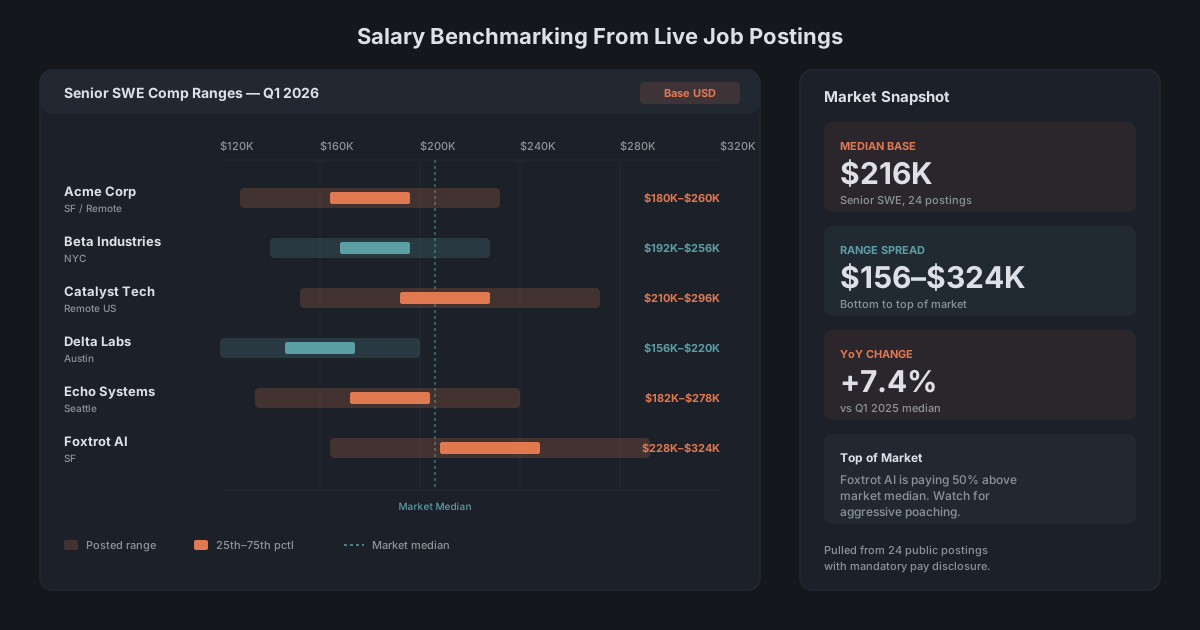
This is your best free source. Period. Colorado, New York, California, and Washington now require salary ranges in job postings. Several other states have similar laws taking effect. When a company posts a range because the law requires it, that range has legal weight. It's not a wish or an aspiration. It's a commitment.
The challenge: you need to find, track, and normalize this data across dozens or hundreds of competitor postings. Manually, this is 4-6 hours per week of tedious work. Fieldwork does it automatically across 27,000+ postings, but if you're bootstrapping, start with your top 5 competitors and track their postings in a spreadsheet.
2. Levels.fyi (Tech Roles)
For software engineering, product management, and data science roles at tech companies, Levels.fyi is surprisingly accurate. The data is crowdsourced but verified against offer letters. It skews toward large tech companies, so coverage for mid-market or non-tech is thin.
3. H1B Salary Disclosures
The Department of Labor publishes H1B visa salary data. This gives you exact base salaries (not ranges) for specific roles at specific companies. The catch: it only covers H1B workers, which skews the data toward certain engineering and data roles, and there's a 6-12 month lag.
4. Glassdoor and Indeed
Self-reported data with no verification. Useful for broad directional signals ("are they paying above or below market?") but not reliable enough for precise benchmarking. The averages often lag the market by a year or more.
5. State and Federal Salary Databases
Public sector organizations publish employee salaries. If you're competing with government or quasi-government entities for talent (common in healthcare, education, defense), this is free and accurate data.
Building a DIY Comp Tracking System
Here's a system that takes about 2 hours per week and produces useful comp intelligence:
Step 1: Define Your Benchmark Roles
Pick 8-12 roles that matter most to your business. Don't try to track everything. Focus on roles where you're losing candidates or where you suspect competitors are outbidding you. Typical priority roles: Senior Software Engineer, Product Manager, Account Executive, Data Scientist, Engineering Manager.
Step 2: Identify Your Competitor Set
Choose 5-10 companies you compete with for talent. These aren't always your product competitors. A fintech startup in Austin competes for engineering talent with Dell, Indeed, and Oracle, not just other fintechs. Think about who your candidates are choosing between you and.
Step 3: Weekly Collection
Every Monday, check each competitor's careers page and note new postings for your benchmark roles. Record: company, title, location, salary range (if disclosed), and any notable requirements. A simple Google Sheet works fine.
Step 4: Monthly Analysis
At month's end, compute ranges for each benchmark role across your competitor set. Where do you fall? Are competitors moving ranges up faster than you? Which roles show the biggest gap?
This is where most people run out of discipline. The first month is interesting. By month three, it's a chore. That's the moment when a tool like Fieldwork pays for itself. The data collection is the boring part. The analysis is where the value lives.
What Good Comp Intelligence Looks Like
Raw salary data isn't intelligence. Intelligence is the answer to "what should we do differently?" Here's what matters:
- Range positioning: Where does your range sit relative to the market? 25th, 50th, 75th percentile? And is that where you want to be?
- Comp velocity: How fast are ranges moving? If your top competitor raised their SWE range by 12% this quarter, you need to know before your next comp cycle.
- Total comp structure: Some companies lead with base salary. Others use equity or bonuses. Job postings increasingly disclose total comp structure. A competitor offering $180K base + $50K equity competes differently than one offering $210K base + $20K bonus.
- Geographic arbitrage: Who's paying SF rates for Denver roles? Who's adjusting by location? This tells you about their remote work strategy and their talent competition map.
The Real Cost of Bad Comp Data
Here's math that most companies haven't done. If you're offering below-market comp because your data is stale, every failed hire costs you:
- Recruiter time: 15-20 hours per search
- Hiring manager time: 8-10 hours of interviews
- Pipeline delay: 30-60 days per restart
- Opportunity cost: whatever that unfilled seat costs in lost revenue
For a $150K role, a failed search easily costs $30K-$50K when you account for all the time and pipeline delays. Do that three times because your ranges are wrong, and you've spent more than a year of Fieldwork's Professional plan.
The SHRM cost-per-hire benchmark pegs average hiring costs at $4,700. But that's the average across all roles. For the competitive technical and go-to-market roles where comp data matters most, the real number is 5-10x that.
When to Invest in a Platform vs. DIY
DIY comp tracking works when:
- You have fewer than 5 competitors to track
- You're benchmarking fewer than 10 roles
- You have someone willing to dedicate 2+ hours per week consistently
- You only need directional data, not precise benchmarks
A platform makes sense when:
- You're tracking 10+ competitors
- You need historical trend data, not just current snapshots
- Multiple teams (TA, comp, CI, sales) need the data
- You can't afford the 6-month ramp-up to build a useful dataset from scratch
Fieldwork sits in the gap between "manually check careers pages" and "sign a $100K Lightcast contract." It's structured comp and hiring intelligence at a price point that doesn't require VP-level budget approval.
What's the cost of not knowing what your competitors pay? If you can't answer that question, you're probably already behind.
Frequently Asked Questions
How can I benchmark compensation without expensive tools?
Use public job posting salary data (from states with pay transparency laws), Glassdoor/Levels.fyi/H1B data, and aggregated job board data. The key is building a consistent tracking system rather than doing ad hoc lookups.
How accurate are salary ranges in job postings?
Ranges in states with mandatory disclosure (CO, NY, CA, WA) are generally accurate because companies face legal risk for misleading ranges. Voluntary disclosures elsewhere can be wider or less precise.
What's the difference between Fieldwork and a comp survey?
Traditional comp surveys (Radford, Mercer) collect self-reported data from participating companies, often with a 6-12 month lag. Fieldwork pulls real-time salary data from active job postings, giving you current market rates for the roles competitors are filling.
How often does compensation data change?
Market rates shift quarterly in fast-moving sectors like tech. Monthly tracking catches significant movements before they compound. Annual surveys miss too much in a dynamic market.
Can I benchmark comp without revealing my own data?
Yes. Job posting data is public. You can analyze competitor pay without participating in any data exchange. Traditional surveys require you to share your own compensation data to access the dataset.