Why Job Postings Are the Best Free Intelligence Source
Every open role on a competitor's careers page is a line item in their budget. Unlike blog posts, conference talks, or press releases, job postings cost real money to fill. Recruiter fees, hiring manager time, onboarding costs. No company spends $15,000-$40,000 per hire on roles they do not need.
That budget commitment is what makes job postings high-signal. When a competitor posts 12 machine learning engineer roles in a single quarter, they are telling you exactly where their product is going. When they open a regional sales office in Singapore, they are telling you which market they are entering next.
The problem is not access. The data is public. The problem is method. Most teams check competitor careers pages occasionally, notice something interesting, and then forget about it. What you need is a repeatable system that turns raw postings into structured intelligence.
The Four Pillars of Job Posting Intelligence
Every job posting contains four categories of intelligence. Track all four consistently and you will build a comprehensive picture of competitor strategy over time.
Pillar 1: Hiring Volume and Velocity
The simplest signal is quantity. How many roles is the competitor posting per month? Is that number going up or down compared to the prior quarter?
Rising volume signals growth investment. Declining volume signals budget pressure, strategic uncertainty, or a shift to efficiency. A sudden drop from 30 monthly postings to 5 often precedes a public announcement about restructuring by 2-3 months.
Track net new postings (new roles added) separately from total open roles (cumulative backlog). A company with 50 open roles that posts 5 new ones per month is in maintenance mode. A company with 50 open roles that posts 25 new ones per month is scaling aggressively.
Pillar 2: Function Mix
What departments are hiring? The ratio of engineering to sales to operations tells you where a company is in its lifecycle and where it is placing bets.
- Heavy engineering hiring: Product investment phase. Building new capabilities or rebuilding existing ones.
- Heavy sales hiring: Go-to-market push. The product is ready and they are trying to capture market share.
- Heavy operations/support hiring: Scaling existing business. Processing more volume of what they already do.
- Heavy executive hiring: Organizational restructuring. New leadership often signals a strategic pivot.
The shift in mix matters more than the absolute numbers. If a competitor historically allocated 60% of hiring to engineering and suddenly shifts to 60% sales, they have decided their product is good enough and are going to market. That is actionable intelligence for your product and sales teams.
Pillar 3: Compensation Data
Pay transparency laws in Colorado, New York, California, Washington, and several other states now require salary ranges in job postings. This is a direct window into competitor cost structure and how aggressively they compete for talent.
Track three things from comp data:
- Range positioning. Are they paying above, at, or below market? Above-market ranges mean they are in acquisition mode and willing to trade margin for speed.
- Function premiums. Which roles get the highest premiums relative to market? If they pay ML engineers 30% above market but backend engineers at market, that tells you where the strategic weight sits.
- Geographic variation. A company paying San Francisco rates for Denver-based roles is either desperate for talent or planning to open a Denver office at premium pricing.
Pillar 4: Skills and Technology Signals
Required and preferred skills in technical job postings reveal the engineering roadmap more accurately than any product blog post.
When a company that has always used Python starts requiring Rust experience, they are rebuilding something performance-critical. When a data team starts listing dbt and Snowflake alongside their existing Redshift stack, they are migrating their analytics infrastructure. When "Kubernetes" and "service mesh" appear in postings from a company that ran monoliths, they are decomposing their architecture.
You do not need to be an engineer to read these signals. Track which technologies appear in postings and watch for additions. New requirements that did not exist 6 months ago are the signal. Stable requirements are noise.
Building Your Collection System
A usable system needs three components: a source list, a collection cadence, and a normalization framework.
Source List
For each competitor, identify where they post jobs. Most companies use a combination of:
- Their own careers page (most complete, often has roles not posted elsewhere)
- LinkedIn (good for volume tracking but often missing salary data)
- Indeed, Glassdoor, and other aggregators (useful for roles that fall off the careers page)
- Niche job boards for specific functions (AngelList for startups, Dice for tech, etc.)
Start with careers pages and LinkedIn. Add other sources only if you notice discrepancies.
Collection Cadence
Weekly collection is the minimum useful cadence. Roles get posted and filled within 2-4 weeks at fast-moving companies. Monthly collection misses roles entirely. Weekly captures the full picture.
Set a recurring calendar block. Every Monday morning, spend 30 minutes scanning competitor careers pages. Log new postings. Note removed postings (filled or cancelled). This discipline is what separates useful intelligence from occasional curiosity.
Normalization Framework
Raw job titles are messy. One company's "Software Engineer III" is another company's "Senior Software Developer." Normalize titles into categories:
- Engineering: Software, data, ML/AI, infrastructure, security
- Product: Product management, design, UX research
- Sales: AEs, SDRs, sales engineering, solutions consulting
- Marketing: Growth, content, brand, demand gen
- Operations: Customer success, support, implementation
- Executive: VP+, C-suite, directors
Consistent categorization is what lets you compare across competitors and track trends over time.
Analysis Framework: From Data to Decisions
Raw data sitting in a spreadsheet is not intelligence. Intelligence is data that has been analyzed and connected to a decision. Here is a framework for turning your collection into something your team can act on.
Monthly Trend Report
Once a month, produce a one-page summary for each competitor covering:
- Total open roles: Current count and trend (up/down/flat vs. prior month)
- New postings this month: Which roles were added?
- Removed postings this month: Which roles were filled or cancelled?
- Notable signals: New locations, new departments, unusual titles, comp changes
- Implications: What does this mean for your company? One sentence connecting the data to a decision.
That fifth item is the most important. "Competitor X posted 8 enterprise AE roles in the northeast" is data. "Competitor X is going upmarket in our strongest region and we should brief our AEs on competitive positioning" is intelligence.
Quarterly Strategic Review
Quarterly, zoom out and look at 90-day patterns:
- Which competitors grew headcount fastest? By which function?
- Which competitors slowed hiring? What might be causing it?
- Are multiple competitors investing in the same area (e.g., AI/ML)? That confirms a market trend.
- Is anyone hiring in a geography or function where you have no presence? That is a potential blind spot.
Real-World Examples of Job Posting Intelligence
Example 1: Detecting a Product Pivot
A B2B SaaS company noticed that a key competitor, historically a CRM vendor, started posting for payment processing engineers and compliance analysts in Q3 2025. Within 6 months, the competitor launched an embedded payments feature that disrupted the market. The companies tracking hiring data had 6 months of advance warning. The companies not tracking it were surprised.
Example 2: Geographic Expansion
A cybersecurity firm tracked a competitor posting 4 roles in Munich and 3 in London over two months, all in sales and solutions engineering. The competitor had never hired in Europe. Three months later, they announced a European headquarters. The cybersecurity firm used the advance warning to accelerate their own European partner agreements.
Example 3: Budget Pressure
A fintech startup noticed their largest competitor's monthly posting volume dropped from 25 to 8 roles over two consecutive months. Engineering postings dried up entirely. Six weeks later, the competitor announced a 15% reduction in force. The startup used the lead time to recruit displaced engineers and pitch the competitor's hesitant customers.
Scaling Beyond Manual Collection
Manual tracking works for 5-10 competitors. Beyond that, the time investment becomes impractical. At 15+ competitors with 20+ postings each, you are looking at 300+ data points per week. That is a full-time analyst role.
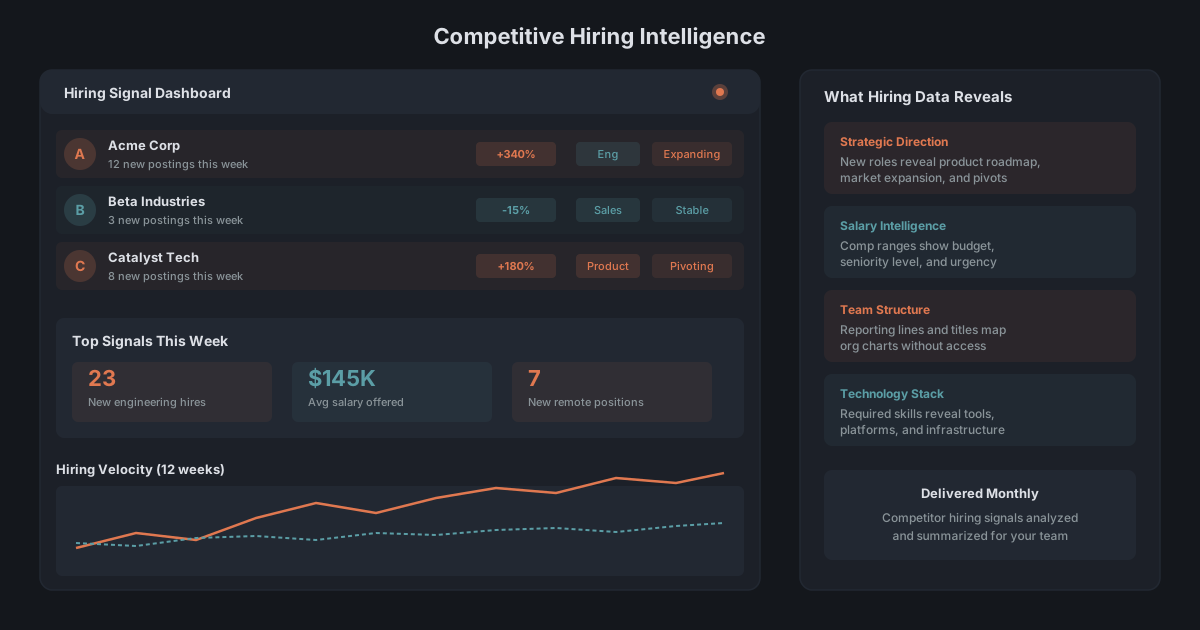
This is where automated platforms earn their value. Fieldwork monitors careers pages, job boards, and LinkedIn for your competitor set continuously. Postings are normalized, categorized, and delivered as structured monthly reports with trend analysis and signal flagging.
The output is the same intelligence you would build manually, but across a broader competitor set with no collection gaps. Whether you build the system yourself or use a tool, the analytical framework above stays the same. See a sample report to understand the output format.
Common Mistakes to Avoid
- Cherry-picking single postings. One job posting is an anecdote. Five postings in the same function over 60 days is a pattern. Never draw conclusions from a single data point.
- Ignoring removed postings. A cancelled role (posted then removed without being filled) is as interesting as a new one. It suggests a budget cut or strategic shift in that area.
- Forgetting your own postings. Your competitors can read your job postings too. Review your own careers page through the lens of competitive intelligence. What signals are you sending?
- Collecting without analyzing. A spreadsheet with 500 rows and no summary is not intelligence. The analysis step is where value is created. If you do not have time to analyze, reduce the scope of collection.
- Treating all competitors equally. Monitor your top 3 competitors deeply (full pillar analysis). Monitor the next 10 at a surface level (volume and notable signals only). This focus prevents data overload.
Job posting intelligence is not complicated. It is systematic. The companies that do it consistently will see competitor moves months before they become public. The ones that do not will keep being surprised. See Fieldwork pricing to start building your competitive hiring intelligence system.
Frequently Asked Questions
What is competitive intelligence from job postings?
It is the practice of systematically monitoring competitor job listings to extract signals about their strategy, growth plans, technology investments, and organizational priorities. Each posting represents a real budget commitment, making it one of the most reliable public data sources.
How do I start collecting job posting intelligence?
Pick 5-10 direct competitors. Set up weekly monitoring of their careers pages and LinkedIn job feeds. Track every new posting in a spreadsheet with fields for title, department, location, salary range, required skills, and date posted. After 30 days you will have enough data to spot patterns.
What tools do I need for job posting intelligence?
At minimum, a spreadsheet and browser bookmarks for competitor career pages. For scale, use an aggregator like Fieldwork that normalizes data across thousands of postings automatically and delivers monthly intelligence reports.
How reliable is job posting data compared to other intelligence sources?
Job postings are among the most reliable public signals because they represent actual budget commitments. A company does not open a requisition, pay recruiters, and allocate headcount budget as a bluff. Compare this to press releases or conference talks, which cost nothing and can be purely aspirational.
Can small companies use job posting intelligence?
Yes. A 20-person startup tracking 5 competitors can do this manually in 2 hours per week. The method scales from a solo founder watching one rival to an enterprise strategy team monitoring 50+ competitors with automated tools.