The Persistent Talent Gap
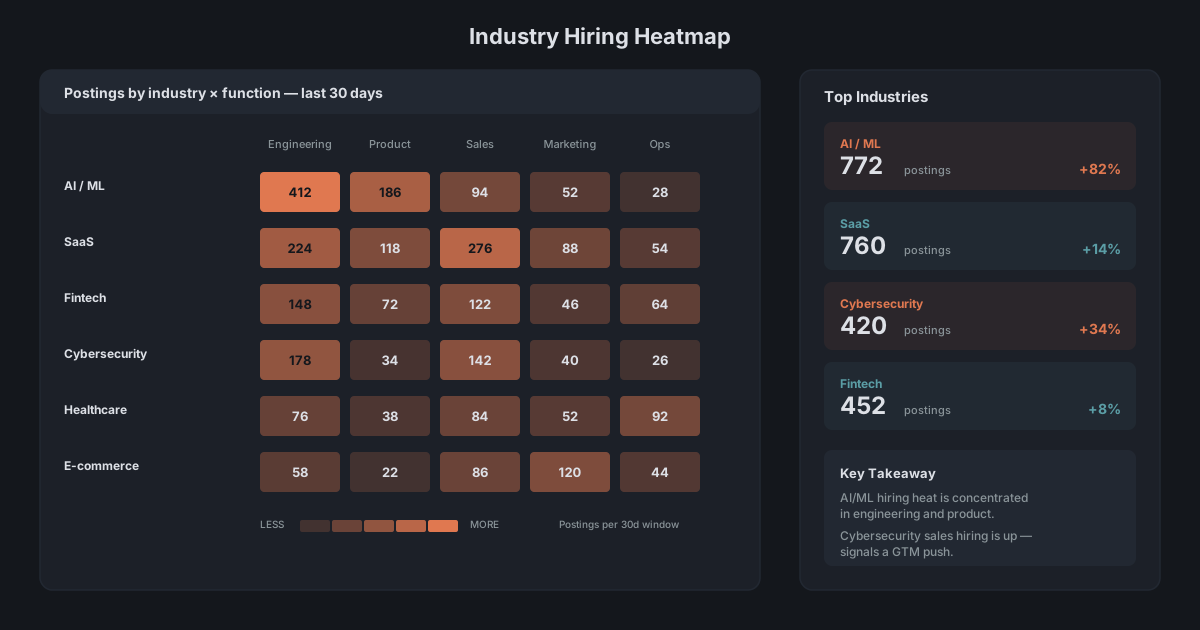
Cybersecurity has the largest supply-demand imbalance of any technology sector. Estimates from ISC2 and CyberSeek place the US workforce gap at roughly 750,000 unfilled positions. Globally, the gap exceeds 3.5 million.
This gap is not new. It has existed since at least 2018. What is new in 2026 is the shape of the gap. Overall cybersecurity hiring demand continues to grow at 12-15% per year. But the growth is concentrated in specific specializations where the talent shortage is most acute: cloud security, AI security, and security engineering (as opposed to security operations).
Understanding where the gap is widest helps companies make smarter hiring decisions. You cannot fill every security role. You can prioritize the ones that matter most.
Where Demand Is Growing Fastest
Cloud Security
Cloud security postings are up 35% year-over-year, making it the largest single growth area in cybersecurity hiring. Every company migrating workloads to the cloud needs security engineers who understand cloud-native architectures.
The roles break into three tiers:
- Cloud Security Engineer: $150K-$200K. Implements security controls in AWS/Azure/GCP. Configures identity and access management, encryption, network security groups, and monitoring. Requires both cloud platform expertise and security fundamentals.
- Cloud Security Architect: $180K-$260K. Designs the overall security architecture for cloud environments. Defines policies, reference architectures, and governance frameworks. Requires 8+ years of combined cloud and security experience.
- Cloud Security Posture Management (CSPM) Specialist: $140K-$185K. Manages tools that continuously assess cloud configuration against security benchmarks (CIS, SOC 2, NIST). Rapidly growing as companies adopt CSPM platforms.
The talent challenge is that cloud security requires dual expertise: deep cloud platform knowledge AND deep security knowledge. Engineers who have both are scarce. Most have one or the other. Time-to-fill for senior cloud security roles averages 90-120 days in our data.
AI/ML Security
AI security is the newest and fastest-growing cybersecurity specialization. As companies deploy AI features, new attack surfaces emerge: adversarial inputs, prompt injection, model extraction, training data poisoning, and AI-generated social engineering.
AI security postings barely existed in 2024. In 2026, they appear at 15% of cybersecurity companies and are growing rapidly. The roles include:
- AI Security Engineer: $165K-$240K. Secures ML pipelines, model serving infrastructure, and AI-facing APIs. Tests for adversarial vulnerabilities. Requires both ML engineering and security background.
- AI Red Team Specialist: $155K-$220K. Conducts adversarial testing against AI systems. Attempts prompt injection, data extraction, and model manipulation. Emerging role that draws from both penetration testing and ML research backgrounds.
- LLM Security Researcher: $170K-$250K. Focused specifically on vulnerabilities in large language models. Prompt injection defenses, output filtering, and jailbreak prevention. Very small talent pool.
The talent pool for AI security is extremely small because the field is new. Most people in these roles transitioned from either ML engineering or traditional security research. Companies hiring for AI security should expect 120+ day time-to-fill and should consider building the capability by cross-training existing ML engineers in security or existing security engineers in ML.
Security Engineering (vs. Security Operations)
The cybersecurity field is experiencing an ongoing shift from security operations (monitoring, alerting, incident triage) to security engineering (building secure systems, automating security controls, developing security tooling).
Security operations hiring is flat or declining slightly, driven by two factors:
- SOAR (Security Orchestration, Automation, and Response) and AI-powered triage are automating Tier 1 SOC analyst work. Fewer analysts can handle the same alert volume.
- Managed detection and response (MDR) services are replacing in-house SOCs at mid-market companies. Companies outsource monitoring and keep engineering in-house.
Security engineering hiring is up 25% year-over-year. These roles build security into the development process rather than bolting it on after deployment. DevSecOps, infrastructure-as-code security, and automated vulnerability management are the core competencies.
Compensation Trends Across Cybersecurity
Cybersecurity compensation continues to outpace general technology roles. The persistent talent shortage gives candidates use that does not exist in most engineering markets.
Entry Level (0-3 years)
- SOC Analyst: $70K-$95K
- Junior Penetration Tester: $85K-$115K
- GRC Analyst: $75K-$100K
- Security Operations Engineer: $90K-$120K
Mid-Level (3-7 years)
- Security Engineer: $140K-$190K
- Penetration Tester: $130K-$180K
- Threat Intelligence Analyst: $120K-$165K
- Security Architect: $155K-$210K
Senior Level (7+ years)
- Principal Security Engineer: $190K-$260K
- Cloud Security Architect: $200K-$280K
- Director of Security Engineering: $220K-$300K
- CISO: $250K-$400K+
Year-over-year, cybersecurity compensation is up 8-12% for mid-level and senior roles. Entry-level compensation growth is more modest (3-5%) as automation reduces demand for junior operations roles.
The CISO Premium
CISO compensation has increased significantly, driven by expanded regulatory requirements, board-level security expectations, and personal liability concerns. In 2026, CISO roles at mid-to-large companies offer $250K-$400K in base salary plus equity and bonus that can double the total package.
The CISO talent pool is small and the role is high-pressure. Average tenure is 2-3 years, creating constant turnover and demand. Companies competing for CISO talent should expect a 4-6 month search and budget accordingly.
Geographic Distribution and Remote Work
Cybersecurity hiring is geographically distributed but with clear concentrations:
- Washington, DC metro: The largest cybersecurity hiring hub, driven by federal government, defense contractors, and proximity to regulatory agencies. 22% of US cybersecurity postings.
- San Francisco/Bay Area: Startup and enterprise cybersecurity vendors. 14% of postings.
- New York: Financial services security. 10% of postings.
- Austin/Dallas: Growing hub, attracted by lower cost of living and corporate relocations. 8% of postings combined.
- Remote: 50% of cybersecurity postings offer remote options, slightly above the general tech average. Security monitoring roles are well-suited to remote work.
The DC concentration creates an unusual competitive dynamic. Companies hiring cybersecurity talent in DC compete not just with other companies but with federal agencies and cleared defense contractors. The security clearance premium (additional $15K-$30K for TS/SCI cleared candidates) further distorts the market in that geography.
Certification Requirements in Hiring
Cybersecurity is one of the few technology fields where certifications significantly affect hiring outcomes. The most-requested certifications in job postings:
- CISSP (Certified Information Systems Security Professional): Appears in 42% of mid-to-senior postings. The de facto standard for security management roles.
- AWS/Azure/GCP Security Certifications: Appear in 35% of cloud security postings. Cloud-specific security credentials are increasingly valued.
- OSCP (Offensive Security Certified Professional): Appears in 60% of penetration testing postings. The gold standard for offensive security skills.
- CISM/CISA: Appear in 30% of GRC and compliance-focused postings.
- CompTIA Security+: Appears in 25% of entry-level postings. The entry point certification.
The data shows that certifications are becoming more, not less, important in cybersecurity hiring. Unlike general software engineering where certifications are often ignored, cybersecurity certifications signal domain-specific knowledge that cannot be easily assessed in a standard technical interview.
Strategies for Hiring in a Talent-Short Market
Strategy 1: Build a Security Training Pipeline
The most effective long-term strategy is to train security professionals internally. Hire strong engineers or IT professionals and invest in their security education. Many companies now fund CISSP, OSCP, or cloud security certification programs for existing employees.
The ROI is compelling. Sponsoring a $5K certification program for an existing employee is far cheaper than paying a $20K-$30K recruiting premium for an external hire who already has the certification.
Strategy 2: Hire Adjacent and Cross-Train
For roles like cloud security engineer, consider hiring cloud engineers and adding security training rather than waiting for candidates who already have both skill sets. The cloud skills are the harder foundation to build. Security principles can be layered on top.
Similarly, for AI security roles, consider hiring ML engineers and providing security training. ML expertise is the scarce foundation. Security assessment methodology can be taught.
Strategy 3: Compete on Mission, Not Just Compensation
Cybersecurity professionals are often mission-driven. The work is inherently meaningful: protecting organizations, safeguarding data, defending against adversaries. Companies that articulate a compelling security mission attract candidates who could earn more elsewhere but choose meaningful work.
In job postings, this means going beyond generic descriptions. Explain what the security team protects, what threats they face, and what impact the role has. Specificity attracts mission-driven candidates.
Strategy 4: Offer Continuous Learning Opportunities
The cybersecurity field evolves rapidly. Threats change, tools change, and regulations change. Professionals who stop learning fall behind quickly. Companies that offer conference budgets, training allocations, lab environments for experimentation, and time for research attract and retain security talent more effectively than those offering only salary.
Strategy 5: Use Hiring Intelligence to Time Your Searches
Track when competitors are hiring for the same security roles. If three competitors post cloud security architect roles in the same month, the talent pool for your search just shrank. Time your postings to avoid peak competition when possible, or be prepared to pay premium compensation during high-competition periods.
Fieldwork's competitive intelligence reports include cybersecurity-specific hiring data, compensation benchmarks, and competition analysis. See pricing to start tracking the security talent market for your competitor set.
Frequently Asked Questions
How big is the cybersecurity talent shortage in 2026?
Industry estimates put the global cybersecurity workforce gap at approximately 3.5-4 million unfilled positions. In the US, there are roughly 750,000 unfilled cybersecurity roles. This gap has persisted for years and is expected to continue through at least 2028.
What cybersecurity roles are hardest to fill?
Cloud security architects, AI/ML security engineers, and incident response leads are the three hardest-to-fill categories in our data, based on time-to-fill and posting duration. All three require deep technical expertise combined with specialized security knowledge that takes years to develop.
What do cybersecurity professionals earn in 2026?
Ranges vary widely by specialization. Security engineers: $140K-$200K. Cloud security architects: $180K-$260K. CISO: $250K-$400K+. Penetration testers: $120K-$180K. GRC analysts: $90K-$130K. AI security specialists command the highest premiums, with senior roles reaching $250K+.
Should I hire cybersecurity specialists or train existing engineers?
Both. For immediate needs (compliance deadlines, incident response capability), hire specialists. For sustained growth, invest in security training for your existing engineering team. Security champions programs, where engineers get security certification and serve as the security point person for their team, are increasingly popular and show up in postings as a desired skill.
How is AI changing cybersecurity hiring?
AI is creating new defensive roles (AI security engineer, ML threat detection specialist) and new offensive concerns (adversarial AI, prompt injection defense). Companies are hiring for both sides. AI is also automating some junior SOC analyst work, which may reduce entry-level security operations hiring over time.