Fintech in 2026: The Compliance Era
If you tracked fintech hiring in 2021-2022, the dominant roles were product engineers, growth marketers, and SDRs. The sector was in hypergrowth mode, fueled by low interest rates and regulatory arbitrage. Build fast, acquire users, worry about compliance later.
"Later" arrived in 2023-2024. Banking-as-a-service partners faced consent orders. Crypto exchanges were prosecuted. Buy-now-pay-later companies faced state lending regulations. The regulatory environment tightened across every fintech vertical.
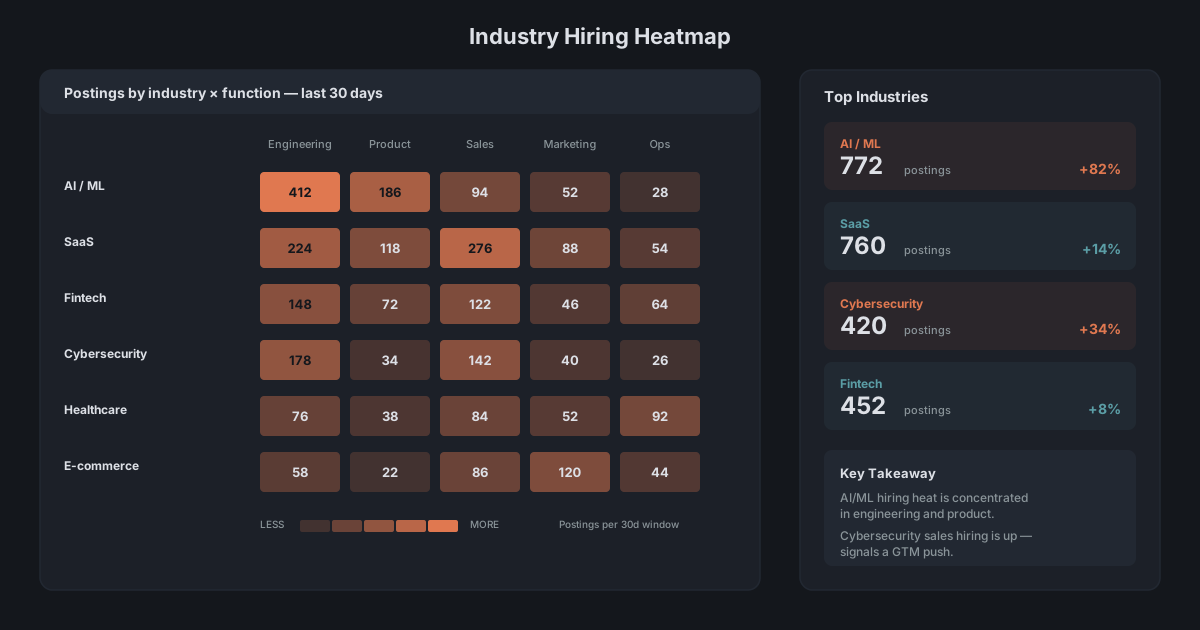
The hiring data in 2026 reflects this new reality. Compliance and risk roles have grown from 12% of fintech postings to 28%. Engineering hiring is stable but has shifted from feature development to infrastructure and compliance tooling. Growth marketing has contracted as customer acquisition economics tightened.
Here is what the data shows across the major fintech segments.
Embedded Finance: The Growth Engine
Embedded finance (integrating financial services into non-financial platforms) is the fastest-growing fintech subsector in hiring data. Posting volume for embedded finance roles is up 55% year-over-year.
The roles fall into three categories:
Integration Engineering
These engineers build the connections between platforms and financial service providers. Typical requirements: API design, webhook infrastructure, idempotent payment processing, and multi-party ledger systems. Compensation: $155K-$210K for senior roles.
The technology stack for embedded finance is converging on a few patterns: RESTful APIs for synchronous operations, webhooks for asynchronous events, and double-entry ledger systems for financial record-keeping. Postings increasingly require experience with specific embedded finance platforms (Stripe Connect, Adyen for Platforms, Marqeta).
Compliance Integration
Every embedded finance deployment requires KYC (Know Your Customer), AML (Anti-Money Laundering), and often state-by-state licensing compliance. Compliance integration engineers build these checks into the product flow. This is a hybrid role combining software engineering with financial regulation knowledge.
These roles are exceptionally hard to fill. Time-to-fill in our data averages 95 days, compared to 55 days for general fintech engineering roles.
Partnership Management
Technical partnership roles that manage relationships between the platform, the fintech infrastructure provider, and the underlying bank partner. These postings have increased because embedded finance requires three-party coordination, and each party has its own compliance and technical requirements.
Payments Infrastructure: The Rust and Go Migration
Payment processing companies are in the middle of a significant technology migration. Job posting data reveals a shift away from Java/Python monoliths toward Rust and Go microservices for core payment processing.
Key data points:
- Rust appears in 22% of payment infrastructure postings, up from 5% in 2024. Companies mention latency requirements (sub-millisecond processing), memory safety, and high-throughput transaction processing as reasons.
- Go appears in 45% of payment infrastructure postings, stable from 2024. Go remains the dominant language for payment microservices due to its concurrency model and operational simplicity.
- Java appears in 38% of payment infrastructure postings, down from 52% in 2024. Legacy system maintenance rather than new development.
This technology migration creates hiring competition between fintech payments companies and general systems engineering shops. A Rust engineer at a fintech needs both language expertise and domain knowledge of financial transaction semantics. That combination is even scarcer than the general Rust talent pool.
The Financial Crimes Compliance Build-Out
Financial crimes compliance (anti-money laundering, sanctions screening, fraud prevention) is the single fastest-growing hiring category in fintech, up 80% year-over-year. Multiple factors drive this:
- Regulatory enforcement: FinCEN and state regulators have increased enforcement actions against fintech companies. Consent orders explicitly require hiring compliance staff.
- Transaction monitoring at scale: As fintech companies process more volume, the need for automated transaction monitoring systems grows proportionally.
- AI-powered compliance: Traditional rule-based AML systems generate too many false positives. Companies are hiring ML engineers to build smarter detection systems.
The roles span a spectrum:
- BSA/AML Analyst: $75K-$110K. Reviews flagged transactions, files SARs (Suspicious Activity Reports), maintains compliance records. Entry point for compliance careers.
- Financial Crimes Compliance Engineer: $145K-$200K. Builds the transaction monitoring systems, sanctions screening integrations, and case management tools. Requires both engineering and compliance domain knowledge.
- Head of Financial Crimes Compliance: $200K-$300K+. Senior leader responsible for the entire compliance program. Typically requires 10+ years in financial compliance and direct regulatory experience.
Crypto and Digital Assets: Rebuilding on Compliance
Crypto hiring peaked in 2022 and crashed in 2023. The 2026 picture is more nuanced. Hiring has recovered to roughly 50% of the 2022 peak, but the composition has fundamentally changed.
In 2022, the top crypto hires were: DeFi protocol engineers, NFT platform developers, and community managers. In 2026, the top hires are: compliance officers, custodial infrastructure engineers, and institutional trading platform developers.
The data tells a clear story: the crypto industry is rebuilding around institutional and regulated use cases. Consumer-facing speculative products are a shrinking share of hiring. Infrastructure for custody, settlement, and regulatory reporting is growing.
- Custodial engineering: Up 60% YoY. Building secure storage, key management, and multi-signature systems for institutional digital asset custody.
- Regulatory reporting: Up 75% YoY. Tax reporting (1099-DA), travel rule compliance, and regulatory filings for digital asset businesses.
- Institutional trading: Up 35% YoY. Order management systems, FIX protocol integration, and institutional-grade execution infrastructure.
Banking-as-a-Service: Cautious Recovery
BaaS (Banking-as-a-Service) went through a difficult period in 2024-2025 as several sponsor banks faced regulatory action for inadequate oversight of their fintech partners. Synapse's bankruptcy in 2024 was a watershed moment.
Hiring data in 2026 shows a cautious recovery. BaaS platforms are hiring, but with a very different profile than 2022:
- Compliance hiring dominates. 40% of BaaS platform postings are compliance-related. This is the highest compliance-to-total ratio of any fintech subsector.
- Bank partnership management. Roles focused on managing the relationship with sponsor banks, ensuring regulatory alignment, and implementing bank oversight requirements. These roles barely existed in 2022.
- Ledger and reconciliation engineering. The Synapse crisis highlighted failures in fund tracking. Companies are now investing heavily in bulletproof ledger systems with real-time reconciliation. Postings requiring double-entry accounting knowledge combined with engineering skills are up 90%.
Fintech Compensation Benchmarks (2026)
Based on salary range data from fintech job postings in states with pay transparency requirements:
Engineering
- Senior Software Engineer: $160K-$210K (slightly above general SaaS)
- Staff/Principal Engineer: $200K-$280K
- Payment Systems Engineer: $170K-$230K (premium for domain expertise)
- Compliance Engineer: $155K-$205K
Compliance and Risk
- BSA/AML Analyst: $75K-$110K
- Compliance Manager: $120K-$165K
- Head of Compliance: $200K-$300K+
- Risk Model Developer: $160K-$220K
Product and Design
- Senior Product Manager: $155K-$200K
- Director of Product: $190K-$250K
- UX Designer (Financial Products): $125K-$165K
Strategic Implications for Fintech Companies
- Compliance is not a cost center anymore. It is a competitive advantage. Companies with mature compliance programs can move faster with regulators and partners. Build compliance teams proactively, not reactively.
- Invest in compliance engineering, not just compliance officers. Manual compliance processes do not scale. The companies winning in 2026 have automated transaction monitoring, real-time screening, and compliance-by-design architecture.
- Plan for the Rust/Go transition. If your payment infrastructure runs on Java or Python and you plan to scale transaction volume, you will eventually need systems engineers with Rust or Go expertise. Start hiring now because the talent pool is small.
- Embedded finance is the growth vector. If you are a fintech platform, your biggest hiring investment should be in integration engineering and embedded compliance. This is where revenue growth is concentrating.
- Budget 15-20% above general tech compensation for specialized roles. Fintech compliance engineers, payment systems architects, and regulatory technology specialists command premiums that non-financial companies do not face. Budget accordingly.
Fintech is maturing from a "move fast and break things" industry into a regulated financial services sector that happens to use modern technology. The hiring data makes this transition impossible to miss. See Fieldwork pricing for fintech competitor intelligence.
Frequently Asked Questions
How is fintech hiring different in 2026 vs. 2023?
The biggest shift is the compliance-to-engineering ratio. In 2023, engineering postings outnumbered compliance postings 4:1 in fintech. In 2026, that ratio is closer to 2:1. Regulatory pressure from banking-as-a-service failures and crypto enforcement has forced every fintech to invest heavily in compliance infrastructure.
What fintech roles are growing fastest?
Financial crimes compliance engineers (up 80% YoY), embedded finance integration specialists (up 55% YoY), and risk modeling engineers (up 40% YoY). Traditional software engineering growth is flat, with hiring concentrated in infrastructure and platform roles rather than feature development.
Are fintech salaries still competitive with big tech?
For specialized roles (compliance engineering, risk modeling, payments infrastructure), fintech compensation is at or above big tech levels. For general engineering roles, fintech pays 5-10% below FAANG but 10-15% above non-tech industry averages. The premium for regulatory expertise is widening.
Is crypto hiring recovering?
Selectively. Infrastructure and compliance roles at established crypto exchanges are growing. Speculative DeFi and NFT project hiring remains well below 2022 levels. The sector is rebuilding on a compliance-first foundation, which means slower but more sustainable hiring growth.
What technologies are fintech companies hiring for?
Core infrastructure: Go, Rust, and Java for payment processing systems. Data and compliance: Python, SQL, and graph databases for transaction monitoring. Cloud: AWS leads with Azure growing, particularly for companies serving bank customers on Azure. AI/ML: Fraud detection, credit scoring, and AML pattern recognition are the primary ML applications.