Executives Do Not Want Your Spreadsheet
You have spent weeks building a competitive hiring database. You have trend lines, function breakdowns, comp benchmarks, and geographic analysis. You are proud of the depth. And if you present it that way, your executive team will nod politely and move to the next agenda item.
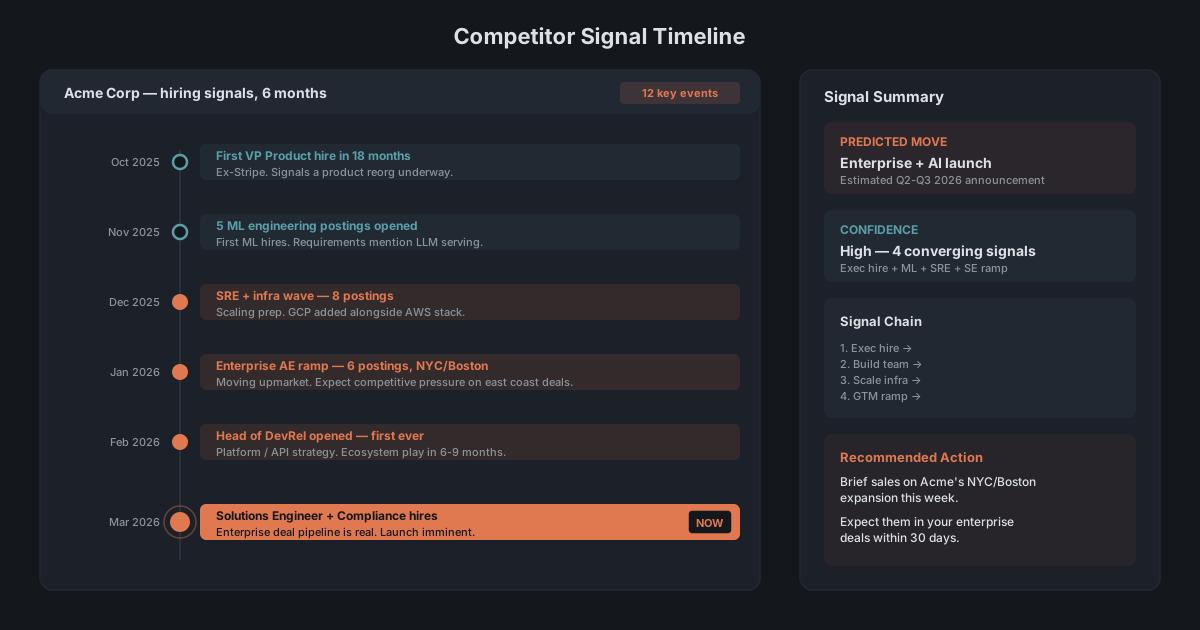
The gap between intelligence and impact is presentation. Not design (no one needs fancy slides). Presentation means: framing data in terms of decisions, not observations. Every piece of hiring intelligence should answer the question "what should we do about this?" If it does not answer that question, it belongs in the appendix.
Here is a format that works. It has been tested in board meetings, executive team offsites, and weekly leadership syncs. Adapt it to your company's cadence and culture.
The One-Page Executive Brief
One page. Not two. Not five. One. If you cannot fit the strategic implications on one page, you are presenting data, not intelligence. Here is the structure:
Section 1: Top Signals This Month (40% of the Page)
Three to five bullet points. Each bullet follows this format: [What happened] + [What it means] + [What we should consider doing].
Example bullets:
- Competitor A posted 12 enterprise sales roles in the Northeast. They are targeting our largest accounts in Q3. Sales should prioritize renewals and expansion in that region before competitive pressure increases.
- Competitor B hired a VP of AI/ML from Google. Expect an AI product announcement within 6-9 months. Product team should evaluate whether to accelerate our AI roadmap or differentiate on reliability.
- Competitor C reduced open roles by 35% this month. Likely a budget cut following their missed earnings. We have a window to recruit their top talent and capture customers who will experience slower support and product velocity.
Notice the format: fact, implication, action. No background explanation needed. If an executive wants to understand the methodology, that is an appendix conversation.
Section 2: Competitive Positioning Table (30% of the Page)
A simple table comparing your company to 3-5 key competitors on hiring metrics that matter:
Columns: Company, Total Open Roles, Quarter-over-Quarter Change, Engineering %, Sales %, New Geos, Avg Comp (Benchmark Role).
This table provides instant context. An executive can see in five seconds whether you are hiring faster or slower than competitors, investing more or less in engineering, and paying more or less for key roles.
Use color sparingly: green when you are in a stronger position, red when competitors have the advantage, neutral otherwise. Do not color everything. Highlight only the 2-3 cells that demand attention.
Section 3: Recommended Actions (30% of the Page)
Two to three specific recommendations. Not vague suggestions. Specific decisions with owners and timelines.
Example:
- Defend Northeast accounts (Owner: VP Sales, Timeline: This quarter). Brief the Northeast team on Competitor A's hiring surge. Schedule renewal conversations for any accounts expiring in the next 6 months.
- Recruit from Competitor C (Owner: VP People, Timeline: Next 30 days). Identify top engineers and PMs at Competitor C. Initiate outreach before the market realizes they are cutting.
- Evaluate AI roadmap acceleration (Owner: VP Product, Timeline: Next executive meeting). Competitor B's AI leadership hire changes our competitive timeline. Present options for accelerating vs. differentiating at the next product strategy review.
Monthly vs. Quarterly vs. Ad Hoc Briefings
Monthly Brief (15 Minutes)
The one-pager described above. Delivered as part of the regular executive meeting cadence. Keep it tight. If there is nothing significant to report, say so in two sentences and give back the time. Executives respect brevity more than volume.
Quarterly Strategic Review (30-45 Minutes)
Once per quarter, go deeper. Pull up from individual signals to market trends. Questions to answer:
- Is the market accelerating or decelerating? (Aggregate hiring velocity across competitors)
- Are competitors converging on the same strategy or diverging? (Function mix comparison)
- Where are we winning and losing the talent competition? (Comp benchmarking)
- What strategic bets are competitors making that we are not? (New role types and technologies)
This is where the full dataset becomes valuable. Show trend lines over 3-4 quarters. Identify inflection points. Connect hiring patterns to known business outcomes (competitor product launches, market entries, earnings results).
Ad Hoc Alerts (Immediate)
Some signals cannot wait for the monthly cadence. A competitor CISO posting at a fintech company. A major rival pulling all job postings overnight. A key competitor hiring in a market you were planning to enter.
For these, send a one-paragraph Slack message or email: what happened, what it likely means, who should be aware. No formatting needed. Speed matters more than polish. Setting up a competitive hiring alert system defines which signals warrant immediate escalation.
Connecting Hiring Intelligence to Strategic Planning
The highest-value application of hiring intelligence is during strategic planning cycles. When your company is deciding where to invest next year, competitive hiring data provides objective input that balances internal bias.
Market Sizing Through Hiring Data
If five competitors are each hiring 10+ people for a specific segment, the market is real and growing. If none of them are investing headcount, either the market is not ready or your competitors have tested and rejected it. Both are useful data points for your own planning.
Competitive Gap Analysis
Map each competitor's hiring by function against your own. Where they are investing and you are not represents either an opportunity you are missing or a mistake they are making. The hiring data does not tell you which, but it ensures you ask the question.
Timing Decisions
Hiring data answers "when" better than most strategic inputs. If a competitor just started building a team for a new product, you have 12-18 months before that product reaches market. If they have been hiring for that product for a year, you have 6 months or less. The hiring timeline constrains the competitive timeline.
Common Mistakes in Executive Presentations
- Leading with methodology. Nobody cares how you collected the data until they care about the conclusions. Start with conclusions.
- Presenting too many signals. Three clear signals beat fifteen ambiguous ones. Edit aggressively.
- Missing the "so what." Every data point needs a business implication. "Competitor X hired 8 engineers" is data. "Competitor X is rebuilding their platform, which gives us 9 months to differentiate" is intelligence.
- Ignoring uncertainty. Not every signal is high-confidence. Flag when you are speculating vs. when the pattern is clear. Executives respect intellectual honesty.
- Presenting without recommendations. Intelligence without recommended action puts the burden on the executive to figure out what to do. That is your job. Come with options.
Fieldwork's monthly competitive reports are designed for executive consumption: structured insights, competitive positioning tables, and actionable signals. See a sample report to evaluate the format for your team.
Frequently Asked Questions
How do I present hiring data to a board or executive team?
Lead with the strategic implication, not the data. Frame every insight as a decision: 'Competitor X is ramping enterprise sales in our territory. We should [defend/attack/invest].' Support with 2-3 data points. Keep the full dataset in an appendix.
What hiring metrics do executives care about?
Executives care about competitive positioning (are we winning or losing the talent war?), market timing (is now the right time to invest or conserve?), and risk (is a competitor about to disrupt our market?). Frame every metric against one of these three questions.
How often should I brief executives on hiring intelligence?
Monthly for routine competitive updates. Immediately for red-alert signals (major competitor pivot, executive hire, hiring freeze). Quarterly for strategic trend analysis that informs planning.
What format works best for executive hiring intelligence briefs?
A one-page summary with three sections: Top Signals This Month (3-5 bullet points), Competitive Positioning Table (your company vs. 3-5 competitors on key metrics), and Recommended Actions (2-3 specific decisions to make). Full data in appendix.