Why Hiring Data Is the Best Leading Indicator
Companies can say anything they want in a press release. They can spin narrative on earnings calls. They can position themselves however they'd like at industry conferences.
But when they spend money on headcount, they're telling the truth. Hiring is one of the few strategic signals that comes with a price tag attached. Every open role represents approved budget, manager conviction, and organizational priority. That's hard to fake.
After analyzing tens of thousands of job postings across hundreds of companies, five patterns consistently predict strategic moves before they're announced. Here's what to watch for.
Signal 1: The Function Shift
A company's hiring mix by function is a real-time view of where they're investing. When that mix changes, something strategic is happening.
Example: a SaaS company that historically hired 60% engineering and 30% sales suddenly flips to 40% engineering and 50% sales. That's a company that's done building and is now in distribution mode. Their product roadmap is probably frozen while they push for revenue.
The reverse is equally telling. A company pulling back on sales hiring while ramping engineering is likely preparing a major product overhaul. They're betting that the current product won't win in the market, so they're rebuilding before scaling again.
Track the ratio of go-to-market (sales, marketing, customer success) to R&D (engineering, product, design, data) hires. Shifts of 15%+ in a quarter are meaningful.
Signal 2: The Geographic Cluster
When multiple job postings appear in a new city within a 60-day window, that's a new office forming. Companies rarely announce satellite offices until they have 10+ people seated. The postings show up months earlier.
In 2024, several AI startups posted clusters of roles in DC and Northern Virginia before announcing government or defense-focused product lines. The location told the story before the product announcement.
International clusters are even more telling. A US-based company hiring 5+ roles in London or Singapore is expanding into that market. Period. You don't build a local team to serve US customers from overseas timezones.
What to track: new cities where a competitor has never posted before. Any city with 3+ postings in a quarter that had zero in the prior year deserves attention.
Signal 3: The Executive Hire
When a company posts for a new VP or C-level role in a function they didn't previously have at that level, they're building a new organizational capability.
A first-ever VP of Data posting means they're getting serious about data products, analytics, or data monetization. A new VP of Partnerships means they're shifting from direct sales to ecosystem distribution. A Chief Revenue Officer posting at a company that previously had a VP of Sales means they're scaling go-to-market and probably raising their next round.
The specificity of executive role descriptions matters too. A VP of Sales posting that mentions "enterprise" or "upmarket" tells you their strategic direction. One that emphasizes "PLG" or "self-serve" tells you the opposite.
The McKinsey org performance blog has documented how executive hiring patterns correlate with strategic pivots.
Signal 4: The Tech Stack Shift
This signal requires some technical literacy, but it's one of the highest-confidence predictors available.
When a company's engineering job postings start requiring a technology they've never mentioned before, they're making a significant technical bet. Examples that have predicted real moves:
- Rust or Go appearing for the first time: Performance-critical systems rebuild. They're replacing something slow with something fast.
- Kubernetes, Terraform, or cloud-native infrastructure: Scaling push. They expect significantly more traffic or complexity.
- ML/AI frameworks (PyTorch, MLflow, vector databases): AI product features incoming. Probably 6-12 months out.
- Compliance or security tools (SOC2, FedRAMP, HIPAA): Entering a regulated market segment. Government or healthcare push likely.
The inverse matters too. When a company stops mentioning a technology they've used for years, they're migrating off it. That migration consumes engineering resources and usually means fewer new features during the transition.
Fieldwork's monthly competitive reports track tech stack mentions across your competitor set so you don't need to parse individual job descriptions.
Signal 5: The Hiring Velocity Change
This is the simplest signal and often the most powerful. Hiring velocity, the number of open roles at any point in time, is a proxy for a company's confidence in their trajectory.
A 50% increase in open roles quarter-over-quarter usually means: they've closed funding, hit a growth milestone, or are executing on a strategic initiative. A 50% decrease means: budget cuts, strategic uncertainty, or a failed initiative being wound down.
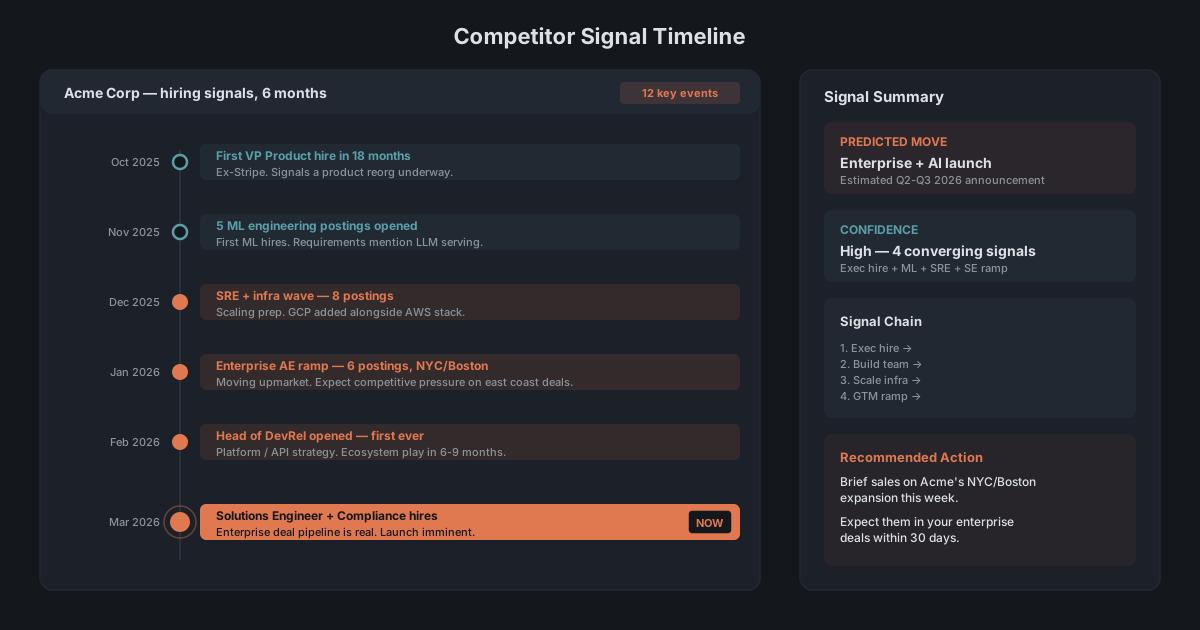
Watch for asymmetric velocity. If a competitor's engineering hiring stays flat while their sales hiring doubles, that's signal 1 (function shift) combining with signal 5. The combination of multiple signals in the same direction creates high-confidence predictions.
How to Calculate Hiring Velocity
Count active open roles for each competitor at the same point each month. Plot the trend. You're looking for inflection points: months where the count jumps or drops by more than 20% versus the prior month.
If you have historical data, calculate the 3-month rolling average. Compare each month's count to the rolling average. A count more than 30% above the rolling average is a surge. More than 30% below is a pullback.
Combining Signals Into Predictions
No single signal is conclusive on its own. The confidence level rises when multiple signals align:
- Function shift toward sales + geographic cluster in new region + executive hire (VP Sales, region): Market expansion into that geography. High confidence.
- Tech stack shift to AI/ML + velocity increase in engineering + new ML executive hire: AI product launch coming. Very high confidence.
- Velocity decrease across all functions + no executive hires + geographic contraction: Company in trouble. Budget cuts or strategic reset.
- Comp increases in specific roles + velocity stable + function mix unchanged: Retention fight. They're losing people to competitors (possibly you) and raising pay to stem the bleeding.
The companies doing this well track 5+ signals across 10+ competitors and review monthly. It sounds like a lot, but with the right system, the data collection is automated and the analysis takes 30 minutes per month. See how Fieldwork structures this for you.
The question isn't whether your competitors are sending these signals. They are. The question is whether anyone at your company is reading them. What signals have you been missing?
Frequently Asked Questions
What are hiring signals in competitive intelligence?
Hiring signals are patterns in job postings that indicate a company's strategic direction. These include changes in hiring volume, new role types, geographic expansion, compensation shifts, and technology stack requirements.
How far in advance can hiring data predict strategy?
Hiring data typically leads public announcements by 3-9 months. A company must hire the team before launching a product, entering a market, or executing a pivot. The hiring precedes the announcement.
How do I distinguish noise from real hiring signals?
Look for sustained patterns, not one-off postings. A single job posting is noise. Five postings in the same function over 60 days is signal. Compare against the company's historical hiring baseline to spot meaningful deviations.
Can hiring signals help sales teams win deals?
Yes. If a competitor is ramping their sales team in your territory, that's an early warning to defend accounts. If they're cutting sales headcount, it may signal an opening to poach their customers. Fieldwork routes these insights to sales teams monthly.