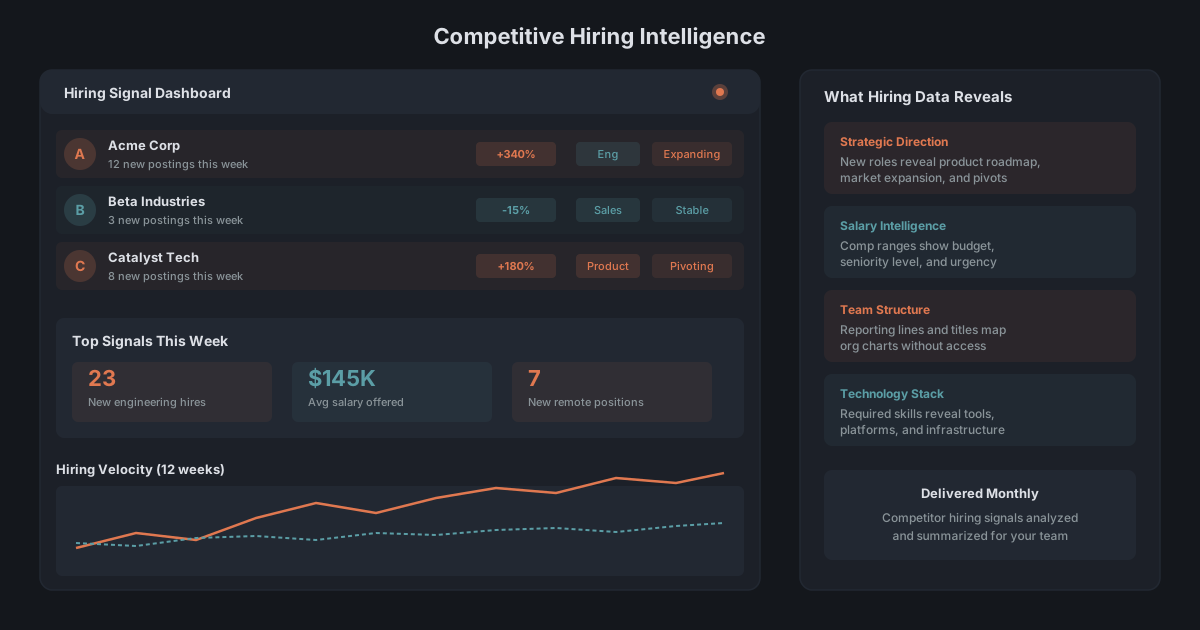
Job Postings Are Public Filings of Intent
Every company with a careers page is publishing a detailed map of where they're headed. Not where they say they're headed in earnings calls or press releases. Where they're spending money.
Most competitive intelligence teams overlook this. They're busy monitoring product launches, pricing changes, and executive quotes. All of which can be staged. But nobody hires 15 machine learning engineers as a bluff.
The signal-to-noise ratio in job postings is unusually high. A company has to pay recruiters, allocate headcount budget, and commit manager time to every open role. That makes each posting a small but real bet on the future. Your job is to read those bets and figure out what game they're playing.
What Job Titles Tell You About Organizational Priorities
Start with the titles themselves. Not the seniority level (everyone has "Senior" in their title now), but the function and specialization.
A company hiring its first "Head of Developer Relations" is signaling a platform play. Three "Solutions Engineer" postings in a quarter means they're pushing upmarket. A "Chief AI Officer" listing tells you they're either serious about AI or serious about appearing serious about AI. Context matters.
Track title velocity, not just title existence. One product manager posting is maintenance hiring. Seven product manager postings in 60 days is a new product line. The pattern matters more than any individual data point.
Titles That Signal Expansion
- Regional Sales Manager (APAC/EMEA/LATAM): Geographic expansion. If they've never had boots on the ground in a region, this is the tip of the spear.
- Enterprise Account Executive: Moving upmarket. Especially telling if they've historically been SMB-focused.
- Developer Advocate / DevRel: Platform or API strategy. They want an ecosystem.
- Compliance / Regulatory roles: Entering a regulated vertical or preparing for international expansion.
Titles That Signal Contraction or Pivot
- Sudden pause in engineering hiring: Budget freeze or strategic uncertainty. Compare to prior quarter volume.
- "Restructuring" or "Transformation" in job descriptions: Reorg in progress. Read between the lines of what they're building next.
- Replacing senior roles that were recently filled: Internal churn. The first hire didn't work out, which suggests unclear strategy.
Location Data: Where They're Planting Flags
Office location tells you as much as the role itself. A company opening an office in Austin is making a different bet than one opening in Singapore. Both are growth signals, but the markets they're chasing are entirely different.
Remote-first companies make this harder to parse, but not impossible. When a "remote" posting specifies a timezone requirement or lists specific metro areas, that's a constraint that tells you something about their customer base or talent strategy.
Watch for clusters. Three hires in the same city over two months is a satellite office forming, even if they haven't announced it. This is often visible in job posting data 3-6 months before the official press release. Bureau of Labor Statistics data can help you contextualize local market dynamics.
Salary Ranges: The Comp Intelligence Most Teams Ignore
Thanks to pay transparency laws in states like Colorado, New York, California, and Washington, more job postings now include salary ranges. This is a goldmine for competitive intelligence that goes beyond HR.
Comp data tells you three things:
- How aggressively they're competing for talent. Above-market ranges mean they're in acquisition mode and willing to pay for speed.
- How they value specific functions. When a company pays ML engineers 40% more than their backend engineers, that tells you where the strategic weight is.
- Their overall cost structure. A company hiring 50 people in San Francisco at top-of-market rates has very different unit economics than one hiring 50 people in Nashville at median.
Fieldwork's monthly reports include comp benchmarking across your competitor set, broken down by function and geography. You can see exactly where rivals are spending more (and less) than you.
Tech Stack Requirements: Reading the Engineering Roadmap
The required and preferred technologies listed in engineering job postings are an unfiltered view of a company's technical direction.
When a company that built everything on AWS starts listing GCP or Azure requirements, they're either multi-cloud or migrating. Both are expensive decisions that reveal strategic priorities.
Similarly, a pivot from monolithic frameworks to microservices (Kubernetes, service mesh mentions) signals a scaling push. New data infrastructure requirements (Snowflake, Databricks, dbt) suggest they're investing in analytics capabilities.
You don't need to be an engineer to read these signals. Look for pattern changes. The same stack listed for two years is business as usual. A sudden shift in required technologies is a leading indicator of product evolution.
Putting It Together: From Data Points to Strategic Narrative
Individual job postings are data points. The value comes from connecting them into a narrative. Here's a framework:
- Volume trend: Are they hiring more or fewer people than last quarter? This is the baseline growth/contraction signal.
- Function mix: What percentage goes to engineering vs. sales vs. operations? Shifts here reveal changing priorities.
- Seniority distribution: Heavy senior hiring means new initiatives. Heavy junior hiring means scaling existing ones.
- Geographic spread: New markets, new offices, or consolidation.
- Comp positioning: Aggressive, market, or below-market. And for which roles.
Track these five dimensions for each competitor monthly. Over a quarter, patterns become clear. Over two quarters, you can start making predictions. Harvard Business Review has noted that hiring data is among the most underused inputs in competitive strategy.
If doing this manually sounds like a lot of work, that's because it is. Fieldwork automates the collection and normalization. You focus on the analysis.
What to Do With What You Find
Intelligence without action is trivia. Once you've identified a hiring signal, route it to the right team:
- Sales: "Competitor X just posted 8 enterprise AE roles in the northeast. Expect them to get aggressive on your accounts in that region. Here's their likely pitch based on the role requirements."
- Product: "Competitor Y is hiring Rust and WebAssembly engineers for the first time. They may be rebuilding their core product for performance. Watch for a re-architecture announcement in 6-9 months."
- Executive team: "Competitor Z's hiring velocity dropped 40% this quarter while ours grew 15%. We have a window to capture market share before they recover."
- Talent acquisition: "Competitor X is offering 20% above market for senior SREs. Either match the comp or accelerate your offer timelines to close candidates before they see competing offers."
The companies that win aren't the ones with the most data. They're the ones that move fastest from signal to decision. And right now, most of your competitors aren't reading your job postings for intel.
Are you reading theirs? See Fieldwork pricing to get started.
Frequently Asked Questions
What can competitor job postings tell you about strategy?
Job postings reveal expansion plans (new office locations), technology bets (required skills), compensation positioning, and organizational priorities. A sudden surge in data engineering hires, for example, often precedes a product pivot.
How often should I review competitor job postings?
Weekly scans catch fast-moving changes. Monthly analysis is enough to spot trends. Fieldwork delivers structured monthly reports covering hiring volume, comp, signals, and geography for up to 25 competitors.
Are job postings reliable indicators of company strategy?
They're one of the most reliable public signals available. Companies can bluff in press releases, but they don't spend money hiring for roles they don't need. The budget commitment makes postings high-signal.
What tools can I use to track competitor hiring?
You can manually check career pages and LinkedIn, use job board aggregators, or subscribe to a competitive hiring intelligence platform like Fieldwork that normalizes and analyzes the data for you.