The State of SaaS Hiring in 2026
SaaS hiring in 2026 looks nothing like 2021. The zero-interest-rate hiring frenzy is over. The 2023-2024 correction (layoffs, hiring freezes, "doing more with less") has stabilized. What emerged is a SaaS hiring market that is smaller but more deliberate, with clear investment themes visible in the data.
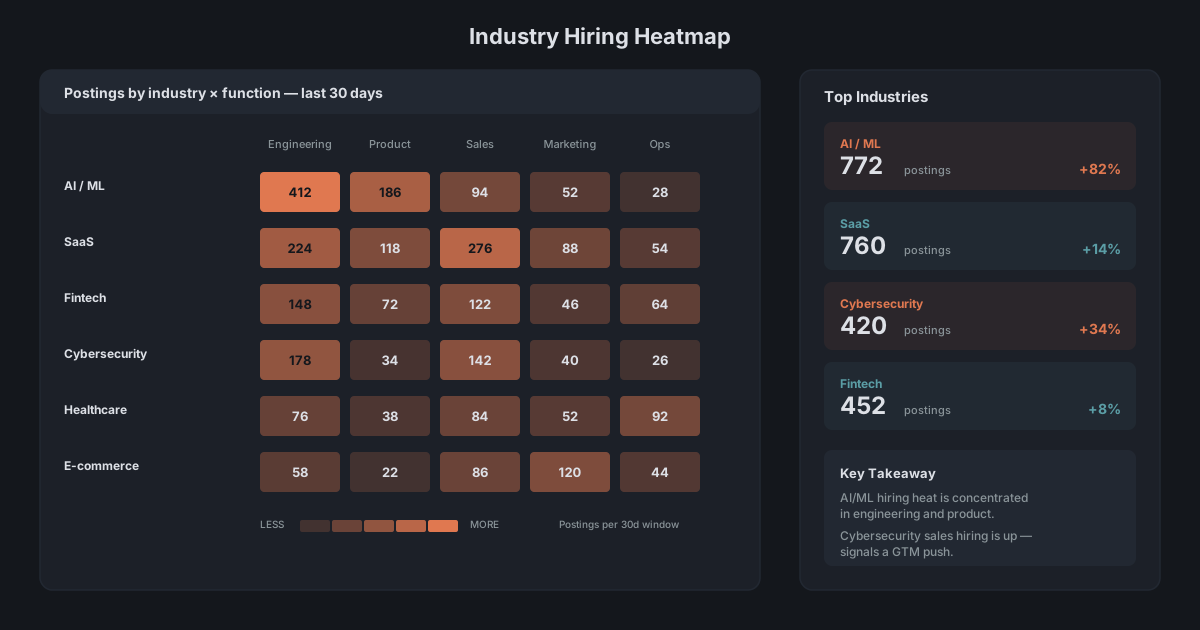
Based on job posting data across 500+ SaaS companies tracked by Fieldwork, three themes dominate: AI integration across every function, a shift from sales volume to sales efficiency, and a major infrastructure rebuild to support AI workloads.
Theme 1: AI Integration Is Everywhere
The most striking pattern in 2026 SaaS hiring data is the spread of AI requirements into non-engineering roles. In 2024, "AI experience" appeared almost exclusively in engineering postings. In 2026, it appears in:
- Product management: 62% of PM postings mention AI product experience, up from 18% in 2024.
- Marketing: 41% mention AI-assisted content, automated campaign optimization, or similar.
- Customer success: 35% mention AI-powered customer health scoring or automated playbooks.
- Sales: 28% mention AI sales tools, automated prospecting, or AI-assisted deal analysis.
This does not mean every company is hiring dedicated AI teams. It means AI literacy has become a baseline expectation across functions, similar to how "proficient in Excel" spread through job postings in the 2000s.
New Roles That Did Not Exist Two Years Ago
Several role titles that did not appear in our 2024 data are now common:
- AI Product Manager: Focused specifically on AI feature development, training data curation, and responsible AI implementation.
- ML Platform Engineer: Building the internal infrastructure for model training, deployment, and monitoring. Distinct from ML researchers/scientists.
- AI Solutions Architect: Customer-facing role helping enterprise clients implement and customize AI features.
- Prompt Engineer / AI Content Strategist: Optimizing prompts and AI-generated content for quality and brand consistency.
These roles sit at the intersection of AI capability and business function. They are not pure research positions. They are implementation and integration roles, which signals that SaaS companies have moved past experimentation into production deployment.
Theme 2: Sales Efficiency Over Sales Volume
The SaaS sales hiring mix has shifted dramatically. In 2021, the typical SaaS sales team hiring plan was heavy on SDRs and AEs. Volume was the strategy: more reps, more pipeline, more deals.
In 2026, the hiring data tells a different story:
- SDR hiring is down 45% from 2022 levels. Many companies have replaced SDR teams with AI-powered outbound or reduced team sizes and increased quality requirements.
- Revenue Operations hiring is up 70%. Companies are investing in the systems and analytics layer that makes existing reps more productive.
- Sales Engineering hiring is up 35%. Technical sales support for complex, high-value deals. This aligns with the broader enterprise push.
- Enterprise AE hiring is up 20%, while SMB AE hiring is down 30%. The SaaS market is moving upmarket.
The strategic narrative is clear: fewer reps, better tooling, larger deals. Companies are trading headcount for efficiency. A RevOps leader who increases rep productivity by 25% is worth more than 5 additional junior SDRs.
The Rise of Revenue Operations
RevOps has moved from an emerging function to a core department. In our data, 78% of SaaS companies with 200+ employees now have at least one open RevOps role. The typical RevOps team is 3-5 people at a 500-person SaaS company, up from 1-2 people in 2023.
RevOps postings typically require: CRM administration (Salesforce or HubSpot), data analysis (SQL, BI tools), process design, and cross-functional collaboration. The best-compensated RevOps roles also require experience with AI-powered sales tools and predictive analytics.
Theme 3: Infrastructure Rebuild for AI Workloads
SaaS companies that adopted AI features in 2024-2025 are now dealing with the infrastructure consequences. AI workloads (model inference, vector search, real-time data processing) have different infrastructure requirements than traditional web applications.
The hiring data shows a surge in infrastructure and platform engineering roles:
- Platform Engineer postings are up 55% year-over-year. These roles focus on internal developer platforms, CI/CD, and infrastructure automation.
- Data Infrastructure Engineer postings are up 40%. Building the data pipelines that feed ML models and analytics systems.
- Site Reliability Engineer (SRE) postings are up 25%. AI features have increased system complexity and the need for reliability engineering.
Technology requirements in these postings reveal the stack evolution: Kubernetes remains dominant, but GPU orchestration tools (Ray, Anyscale) are appearing in 30% of ML-related infrastructure postings. Vector databases (Pinecone, Weaviate, pgvector) appear in 25% of data infrastructure postings, up from near zero in 2024.
Compensation Trends in SaaS
SaaS compensation in 2026 is bifurcated. AI-adjacent roles command significant premiums. Non-AI roles are flat or growing modestly.
Roles With Rising Compensation (10%+ YoY)
- ML/AI Engineer: median $185K-$240K (up 15% YoY)
- Staff+ Software Engineer: median $190K-$250K (up 12% YoY)
- Revenue Operations Director: median $150K-$200K (up 10% YoY)
- AI Product Manager: median $165K-$220K (new category, benchmarking against prior-year PM data shows 18% premium)
Roles With Flat Compensation (0-5% YoY)
- Mid-level Software Engineer: median $130K-$165K (up 3% YoY)
- Account Executive (Mid-Market): median $120K-$150K base, $240K-$300K OTE (flat)
- Customer Success Manager: median $85K-$115K (up 2% YoY)
- Product Designer: median $120K-$155K (up 4% YoY)
Roles With Declining Demand (Not Necessarily Comp)
- SDR/BDR: posting volume down 45%, comp flat at $55K-$75K base
- Junior QA Engineer: posting volume down 30%, increasingly automated
- Marketing Coordinator: posting volume down 25%, AI tools handling coordination tasks
Geographic Distribution
SaaS hiring geography continues to disperse, but unevenly:
- San Francisco/Bay Area: Still the largest single market but declining share (28% of postings, down from 35% in 2023). Concentrated in senior and AI roles.
- New York: Stable at 18% of postings. Strong in sales, marketing, and fintech-adjacent SaaS.
- Austin: Growing to 8% of postings (up from 5% in 2023). Attracting mid-stage SaaS companies.
- Remote: 38% of postings specify remote eligibility, down from a peak of 52% in 2022. The hybrid push is real.
For companies building workforce plans, the geographic data suggests: locate engineering in lower-cost metros or remote, locate enterprise sales near customer concentrations (NYC, Chicago, Dallas), and maintain a Bay Area presence for senior hiring and AI talent.
What This Means for Your Strategy
If you are running a SaaS company in 2026, the hiring data suggests five strategic implications:
- Invest in AI integration, not AI research. The market is hiring implementers, not researchers. Build capabilities to integrate AI into your product, not to invent new models.
- Shift sales investment from volume to efficiency. RevOps, sales engineering, and automation yield better ROI than adding headcount.
- Budget for infrastructure investment. AI features require infrastructure upgrades. Plan for it or your product performance will degrade.
- Pay the premium for scarce skills. AI engineers and Staff+ engineers command premiums. Trying to hire below market extends timelines and reduces quality.
- Embrace hybrid. Fully remote is losing share. Fully in-office limits your talent pool. Hybrid with 2-3 office days is where most SaaS hiring is converging.
These trends are based on aggregate job posting data across 500+ SaaS companies. Your specific market segment may differ. Request a Fieldwork sample report to see trends specific to your competitor set and industry vertical.
Frequently Asked Questions
What are the biggest SaaS hiring trends in 2026?
Three dominant trends: AI integration roles appearing across all departments (not just engineering), a shift from volume sales hiring to efficiency-focused roles like revenue operations and sales enablement, and significant infrastructure/platform engineering investment as companies rebuild for AI workloads.
Is SaaS still hiring in 2026?
Yes, but with a different profile than 2021-2022. Total SaaS hiring volume is roughly 60% of the 2021 peak but is growing steadily. The mix has shifted heavily toward AI-adjacent roles, go-to-market efficiency roles, and platform engineering. Pure growth hiring (SDR armies, junior developer cohorts) has been replaced by targeted, higher-seniority hiring.
What SaaS roles are hardest to fill in 2026?
ML/AI engineers with production deployment experience (not just research), Staff+ engineers with distributed systems expertise, and revenue operations leaders who combine data analysis with go-to-market strategy. These roles have the widest salary ranges and longest time-to-fill in our data.
Are SaaS companies still hiring remote?
The split varies by role. Engineering roles are approximately 55% remote, 30% hybrid, 15% in-office. Sales roles are 40% remote, 35% hybrid, 25% in-office. Executive roles are 20% remote, 40% hybrid, 40% in-office. The overall trend is toward hybrid with required office days, moving away from fully remote.
How has AI affected SaaS hiring?
AI has created new roles (AI product manager, ML platform engineer, AI solutions architect) while changing existing ones (product managers now need AI fluency, marketers need prompt engineering basics). Total headcount impact is roughly neutral for now: some roles are augmented by AI, but new AI-specific roles offset any reduction.