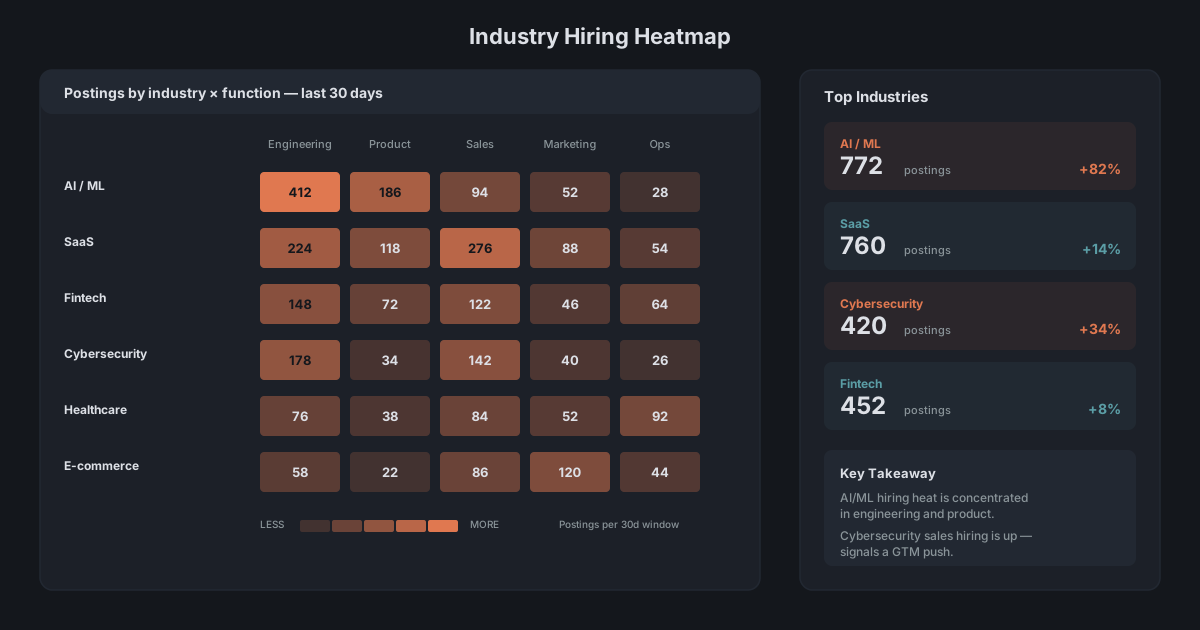
SaaS Companies Cannot Hide Their Strategy
Every SaaS company with a careers page is publishing a real-time strategy document. Most competitors and investors ignore it. The ones who pay attention gain an information advantage that compounds over time.
SaaS is uniquely readable through hiring data because the business model is well understood. When you see a SaaS company hiring 10 enterprise account executives, you know exactly what that means: they are pushing upmarket, probably targeting $50K+ ACV deals, and expect to ramp quota-carrying reps within two quarters. There is no ambiguity.
The same clarity applies across functions. Product hires signal feature investment. Customer success hires signal retention focus. Platform engineering hires signal an API or integration strategy. Each hire maps directly to a business outcome in SaaS because the playbook is well documented.
The Five SaaS Hiring Patterns That Matter Most
1. The PLG-to-Enterprise Shift
This is the most common and most consequential pattern in SaaS right now. Companies that built their initial traction through product-led growth are layering on enterprise sales motions. You can see it coming months before the press release.
The signals: first Solutions Engineer posting. First "Enterprise" in a sales title. A new VP of Sales hired from a company known for top-down selling. Security and compliance roles appearing for the first time (SOC 2, HIPAA, FedRAMP). Each of these individually means something. Together, they are a clear declaration of strategic direction.
Why it matters competitively: if you sell to the enterprise and a PLG competitor is making this shift, you have 6-12 months before their reps are ramped and hitting your accounts. That is your window to lock in contracts and deepen relationships.
2. The International Expansion Signal
SaaS companies expanding internationally follow a predictable hiring pattern. First, a country manager or regional sales lead. Then local customer success. Then local marketing. Finally, engineering if they need data residency or localization.
The location alone tells you which market. A cluster of hires in London means EMEA. Singapore or Sydney means APAC. Sao Paulo means Latin America. Each market has different competitive dynamics, and knowing a competitor is entering a new geography gives you time to prepare.
Track any competitor postings in cities where they have never hired before. Three or more postings in a new country within 90 days is a confirmed expansion signal.
3. The Platform Play
When a SaaS company starts hiring Developer Relations, Developer Experience engineers, API product managers, and partner managers, they are building a platform. This is one of the most important strategic shifts a SaaS company can make because it changes the competitive moat.
A product is a tool. A platform is an ecosystem. The hiring pattern is unmistakable: DevRel, SDK engineers, marketplace or integrations team, partner sales. If you see three or more of these roles at a competitor, they are going platform.
The competitive implication is significant. Platforms create switching costs. If your competitor builds an ecosystem of integrations and your product remains standalone, their retention will improve dramatically within 18-24 months.
4. The AI Integration Wave
In 2026, the SaaS companies hiring ML engineers and AI product managers are the ones building AI into their core product. The ones hiring "AI" in marketing titles are the ones building landing pages about AI. The job function tells you which category a company falls into.
Look at the specific AI roles. Hiring for ML infrastructure (MLOps, model serving, feature stores) means they are building real capabilities. Hiring only for "AI product marketing" means they are wrapping an API call in a button and calling it AI. The distinction matters for competitive positioning.
The Stanford AI Index tracks broader AI adoption metrics, but job posting data gives you company-specific intelligence that aggregate reports cannot.
5. The Efficiency Mode Signal
When a SaaS company freezes hiring across the board but opens roles in revenue operations, finance, and data analytics, they have entered efficiency mode. Growth-at-all-costs is over for that company. They are optimizing unit economics.
This pattern became widespread in 2023-2024 and continues selectively. The tell is not just reduced hiring volume but a shift in the type of hiring. Fewer quota-carrying sales reps. More RevOps and enablement. Fewer new-product engineers. More infrastructure and reliability engineers. The company is squeezing more output from its existing resources.
Reading SaaS Market Cycles Through Aggregate Hiring Data
Individual company signals are useful. Aggregate signals across the SaaS market are even more powerful.
When you track 25+ SaaS competitors simultaneously, patterns emerge that no single company's data would reveal. If 60% of your competitive set is adding enterprise sales headcount at the same time, that is not coincidence. The market is moving upmarket. If 40% are cutting marketing spend (visible through reduced marketing team hiring), demand generation is getting harder across the sector.
These aggregate signals help you time your own investments. Hiring into a trend early gives you a 6-month ramp advantage over followers. Hiring signals as leading indicators work even better when you track enough companies to separate individual noise from market signal.
Building a SaaS Hiring Intelligence Dashboard
If you want to track SaaS hiring signals systematically, here is what to monitor monthly for each competitor:
- Total open roles: Raw growth/contraction indicator. Compare quarter over quarter.
- Function mix: Percentage split across engineering, sales, marketing, CS, G&A. Track shifts of 10%+ as significant.
- New role types: Any title or function they have never posted before. First-ever DevRel, first-ever enterprise AE, first-ever compliance hire.
- Geography: New cities or countries appearing in their postings.
- Comp ranges: Where they sit relative to market for key roles. Rising ranges mean aggressive talent acquisition.
- Tech stack: New frameworks, languages, or infrastructure tools appearing in engineering requirements.
Doing this manually for 5 competitors takes 3-4 hours per week. For 15-25 competitors, it is a full-time job. Fieldwork automates the collection and delivers the analysis so you spend time on decisions, not data entry.
What SaaS Leaders Do With This Intelligence
The best SaaS operators use hiring intelligence to make three types of decisions:
- Competitive positioning: If a competitor is hiring heavily for a new vertical (visible through industry-specific sales and CS roles), you can either race to get there first or double down on verticals they are ignoring.
- Talent strategy: If three competitors are all hiring senior Golang engineers in Austin, you know the talent market is about to get tight. Adjust your offers before you start losing candidates.
- Sales intelligence: When a competitor's customer success hiring drops while their sales hiring stays flat, churn is likely rising. Their existing customers may be open to conversations. Sales teams that use hiring data close deals that others miss.
The SaaS market moves fast. Quarterly strategy reviews based on last quarter's data are not fast enough. You need real-time signals from the most reliable public data source available: where companies are spending their headcount budget.
See how Fieldwork tracks SaaS hiring signals across your competitive set.
Frequently Asked Questions
What do SaaS hiring trends reveal about market direction?
SaaS hiring patterns show which segments are growing, which business models are winning, and where consolidation is likely. A shift from PLG to enterprise sales hiring across multiple companies signals a market-wide maturation trend.
How can I track SaaS competitor hiring?
Monitor careers pages, LinkedIn job feeds, and aggregator sites weekly. Track open roles by function, seniority, and location. Fieldwork automates this across your full competitor set and delivers monthly trend analysis.
What SaaS roles signal a company is preparing to IPO?
IPO-track companies typically hire for SEC reporting, investor relations, SOX compliance, internal audit, and FP&A within 12-18 months of filing. A sudden cluster of finance and legal hires at a late-stage SaaS company is a strong IPO indicator.
How do hiring patterns differ between PLG and enterprise SaaS?
PLG companies hire heavier on product, growth engineering, and data roles. Enterprise SaaS loads up on field sales, solutions engineering, and customer success. The ratio tells you which motion a company is betting on.