The Intelligence Gap in Most Sales Orgs
Sales teams obsess over product comparisons. Feature matrices. Pricing sheets. Win/loss analysis. These are all backward-looking: they tell you what happened in deals that already closed.
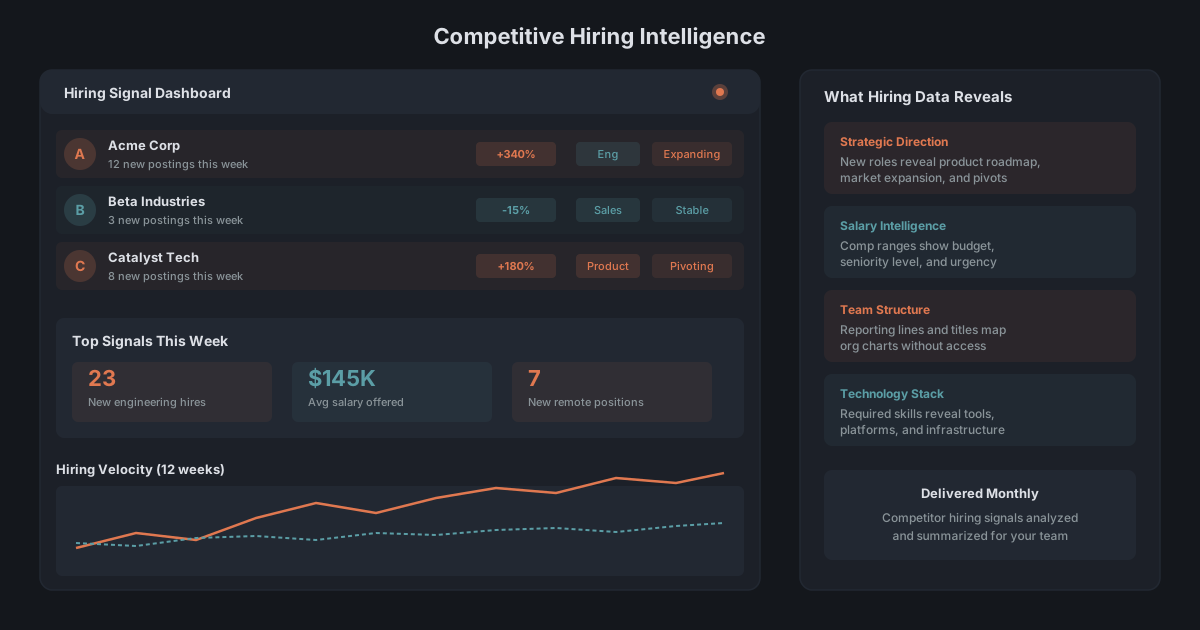
What most sales orgs lack is a forward-looking competitive signal. Something that tells you what's about to happen in your market, your territory, and your deals before it happens. Hiring data is that signal.
When a competitor posts 12 new Account Executive roles concentrated in the Northeast, that's not HR housekeeping. That's a territory assault. You have 60-90 days before those AEs are ramped and calling on your accounts. The sales leaders who see this signal early adjust. The ones who don't get surprised.
Four Ways Hiring Data Changes Sales Strategy
1. Territory Defense
A competitor ramping sales headcount in your best region is the clearest competitive threat you can observe. Here's what that signal looks like in practice:
- 3-5 new AE postings in a region: They're testing the market. Increase your account coverage in that region now, before their reps are ramped.
- Regional Sales Manager or VP Sales posting in a new geo: They're committing to the market long-term. This isn't a test. Prioritize retention plays with your top accounts in the region.
- SE (Solutions Engineer) postings alongside AE postings: They're going after enterprise accounts. SMB-focused defense won't work. Elevate your enterprise selling motion.
Action: share competitor hiring intelligence with regional sales leaders monthly. When a competitor ramps in their territory, they should increase touch frequency with top accounts and accelerate any stalled deals before new competition arrives.
2. Objection Handling
Some of the best sales objections are powered by hiring intelligence. Examples:
Prospect says: "We're also looking at [Competitor X], they seem like they're investing heavily in [feature area]."
With hiring data, you can respond: "I track their hiring data closely. They posted their first product manager for [feature area] three months ago and have two open engineering roles. They're about 12-18 months from shipping anything meaningful there. We've had a team on this for two years and already have [specific capability] in production. Let me show you."
This kind of response demonstrates market awareness that prospects rarely encounter. It positions you as someone who understands the competitive landscape at a level that earns trust.
Another scenario. Prospect says: "We're worried about [Competitor X]'s long-term viability."
With hiring data: "That's a fair concern. Their engineering team has grown 30% this year and they just hired a new CRO from [well-known company]. The investment signals are positive. But if you look at what they're building, it's mostly infrastructure catch-up, not new capabilities. Our roadmap is 18-24 months ahead."
Or conversely: "I'll be direct. They've reduced hiring by 40% this quarter and several senior engineers have left for [Company Y]. I can't tell you what that means for their financials, but I can tell you we're growing and shipping. Here's our most recent release notes."
3. Deal Timing
Hiring data helps you time your outreach to prospects, not just defend against competitors.
When a prospect company starts hiring for a function that your product supports, that's a buying signal. Examples:
- Company posts first "Revenue Operations" role: They're building the function. They'll need RevOps tools in 3-6 months.
- Company posts multiple "Data Engineer" roles: Data infrastructure investment. They'll need data tools.
- Company posts "VP of Customer Success": They're formalizing post-sale. They'll need CS platform tooling.
The hiring event tells you when to reach out. Not too early (they haven't started), not too late (they've already bought). The window between "first hire in function" and "function has a leader and a budget" is the sweet spot.
4. Identifying Weakness
When a competitor's hiring data shows contraction, that's an opportunity to go after their customers. Signals to watch:
- Customer Success team shrinking: Their accounts are getting less attention. Reach out to their customers with a high-touch pitch.
- Engineering headcount declining while CS headcount grows: They're in firefighting mode. Product is stalling while they manage churn. Their customers are feeling the pain.
- Long-unfilled senior roles: A VP of Engineering posting open for 6+ months means internal dysfunction. Projects are delayed. Customers are affected.
The Gartner sales research increasingly emphasizes intelligence-driven selling. Hiring data is one of the most underused inputs in the sales intelligence stack.
How to Operationalize Hiring Intel in Your Sales Org
Intelligence that stays in a dashboard doesn't close deals. Here's how to make it actionable:
Monthly Competitive Brief
A one-page document for the sales team covering:
- Top 3 competitor hiring moves this month
- Which territories are most affected
- Recommended actions (defend, attack, time deals differently)
This should take 15 minutes to read and directly impact next week's activity. Fieldwork's monthly reports include a sales-ready summary for exactly this purpose.
Deal-Level Intelligence
When a specific deal involves a competitor, pull the hiring data for that competitor. Include in your deal strategy: their current engineering investment in the product area, their sales team's size and trajectory in the region, and any leadership changes that might affect their ability to deliver.
QBR Integration
Add a competitive hiring data slide to your quarterly business reviews. Show the team how competitor investment has shifted. Use it to set strategic priorities for the next quarter: where to defend, where to attack, and where to differentiate.
The ROI Case for Sales Hiring Intelligence
Assume your average deal size is $50K ARR and you run 100 competitive deals per quarter. If hiring intelligence helps you win just 2 additional deals per quarter, that's $400K in annual incremental revenue from an intelligence investment that costs less than a single enterprise software seat.
Most sales leaders will invest $10K-$50K per rep in sales engagement tools, CRM seats, and training. An investment in competitive hiring intelligence costs a fraction of that and arms every rep with information their competitors' reps don't have.
What's your competitor's sales team doing right now? If you can't answer that question, you need to start watching. See Fieldwork pricing.
Frequently Asked Questions
How can sales teams use competitor hiring data?
Sales teams use hiring data to anticipate competitor moves in specific territories, handle objections about competitor capabilities, time outreach to prospects, and identify accounts where competitors are pulling back investment.
What hiring signals should sales leaders monitor?
Sales team expansion (new AE hires by region), product investment signals (engineering hires that indicate new features), customer success scaling (CS hires that indicate growing customer base), and leadership changes (new CRO or VP Sales).
How does hiring data help with deal strategy?
If a competitor is ramping their sales team in your territory, expect more aggressive pricing and outreach. If they're cutting, their existing customers are vulnerable. If they're hiring product roles in your space, prepare for feature parity arguments.
Can hiring data tell you about a competitor's financial health?
Yes. Sustained hiring growth correlates with positive financial trajectory. Hiring freezes, layoffs, and unfilled senior roles often precede public announcements of financial difficulty. For private companies, hiring data is one of the few visible financial indicators.
How often should sales teams review hiring intelligence?
Monthly is sufficient for strategic planning. Weekly alerts for high-priority competitors (large sales team additions, new office locations) help with tactical response. Fieldwork delivers monthly reports with the option to flag urgent changes.