Beyond Recruiting: Talent Data as a Strategic Asset
Most companies treat hiring data as an HR concern. Recruiters track open roles, time-to-fill, and offer acceptance rates. This is important but narrow. It looks inward at your own hiring process and misses the larger picture.
The larger picture is this: the labor market is the best leading indicator of economic activity. Companies hire before they grow and cut before they shrink. If you can read aggregate hiring patterns across your industry and competitor set, you can predict market movements months ahead of official economic data.
This is talent market intelligence. Not recruiting optimization. Strategic planning informed by workforce data. It answers questions like:
- Is our industry growing or contracting? By how much and in which segments?
- Which skills are becoming more valuable? Which are becoming commoditized?
- Are competitors investing in the same areas we are, or are we alone in a market?
- Is talent supply tightening or loosening for our critical roles?
The Five Data Streams of Talent Intelligence
Stream 1: Industry Hiring Volume
Aggregate job posting volume across an industry is the broadest signal. The Bureau of Labor Statistics publishes monthly JOLTS (Job Openings and Labor Turnover Survey) data, but it lags by 6-8 weeks and is too broad for sector-specific decisions.
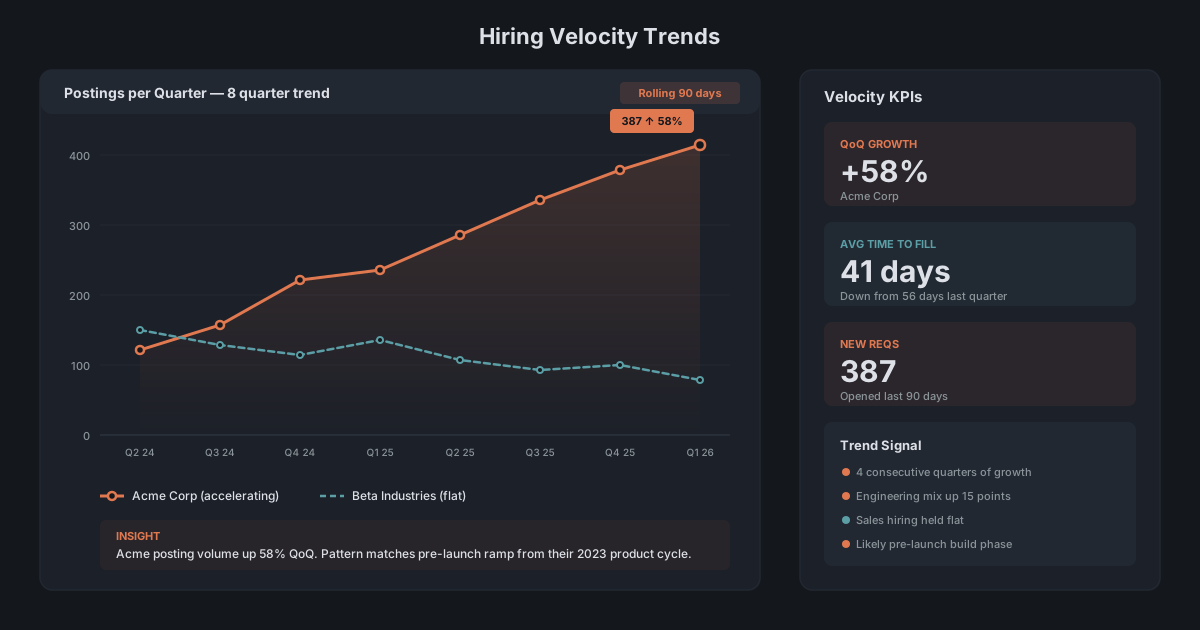
For real-time industry signals, track job posting volume from the 20-30 largest companies in your sector. Sum their monthly postings. Plot the trend. A sustained increase over 3+ months means the industry is investing. A sustained decrease means caution.
Compare your industry to adjacent ones. If SaaS hiring is flat but fintech hiring is surging, capital is flowing to fintech. If healthcare tech is booming while general healthcare is flat, the technology layer is where growth is concentrated.
Stream 2: Skill Demand Shifts
The technologies and capabilities that companies are hiring for change over time. Tracking these shifts reveals where the market is moving before product announcements make it obvious.
In 2024-2025, the clearest example was AI/ML hiring. Companies across every industry started adding machine learning requirements to roles that previously had none. Product managers needed "AI product experience." Data analysts needed "prompt engineering." Marketing roles required "AI-assisted content strategy." The hiring data showed the AI adoption wave 6-12 months before most companies launched AI features.
Track the top 20 skills mentioned in your industry's job postings. Rank them quarterly by frequency. Watch for:
- New entries: A skill that was not in the top 20 last quarter but is now. This is an emerging requirement.
- Rising skills: A skill that moved up 5+ positions. Demand is accelerating.
- Declining skills: A skill that dropped 5+ positions. The market is moving away from it.
- Stable skills: Skills that stay in the same position quarter over quarter. These are table stakes, not differentiators.
Stream 3: Compensation Trends
Rising compensation for a role signals supply-demand imbalance. There are more companies trying to hire than there are qualified candidates. Falling (or flat) compensation signals the opposite.
Track median salary ranges for your 10-15 benchmark roles quarterly. When a role's median rises by more than 5% in a quarter, the market is tightening. When it stays flat or drops, the market is loosening.
Comp trends also reveal which skills are becoming premium. In 2025, AI/ML engineering compensation rose 15-25% while general backend engineering stayed flat. That spread tells you exactly which skills the market values most.
Stream 4: Geographic Patterns
Where companies hire reveals where economic activity is concentrating. Track the distribution of job postings across metropolitan areas for your industry.
Five years ago, the answer for tech was simple: San Francisco, New York, Seattle. Today, the landscape is more distributed. Austin, Miami, Nashville, Denver, and Raleigh have all attracted significant tech hiring. Tracking which cities are gaining share and which are losing it helps with:
- Office location decisions: Open offices where talent is concentrating, not where it was 5 years ago.
- Competitive density: Cities with high competitor hiring density mean more talent competition. Cities with low density but growing talent pools are opportunities.
- Remote vs. in-office trends: The percentage of remote postings varies by industry and is still shifting. Track it for your sector.
Stream 5: Competitor Workforce Composition
The final stream brings it back to specific competitors. What does their workforce look like and how is it changing?
Use LinkedIn data, job postings, and public filings to estimate competitor workforce composition by function. Then track changes quarterly. This is covered in detail in our competitor hiring analysis guide.
Strategic Planning Applications
Application 1: Market Sizing and Timing
If you are evaluating entry into a new market or segment, talent data tells you whether the market is growing. Aggregate hiring volume in that segment, tracked over 4-6 quarters, shows the investment trajectory. Companies entering growing markets hire. Companies in shrinking markets cut.
This is especially useful for identifying market timing. If hiring in a segment has been growing for 4 quarters and just started decelerating, you may be late. If it is early in an acceleration curve (2-3 quarters of growth), the window is open.
Application 2: Investment Prioritization
When choosing between two strategic investments, check the talent data. If Investment A requires skills that are abundant and stable-priced, execution risk is lower. If Investment B requires skills that are scarce and price-inflating, execution will be harder and slower.
A company deciding between a Python-based analytics product and a Rust-based performance product should know that Python talent is 10x more abundant and 30% cheaper. The technical decision has business implications that only talent data reveals.
Application 3: Competitive Positioning
If three competitors are all heavily investing in AI/ML hiring while you are not, that is a positioning signal. You can either match the investment (compete on the same axis) or explicitly differentiate (our product works without AI complexity). Both are valid strategies. But making that decision without knowing what competitors are doing is flying blind.
Talent data also reveals competitive blind spots. If no competitor is hiring for a specific capability (say, compliance automation in your vertical), that may be an underserved need. You can invest there without competition.
Application 4: Risk Assessment
Talent supply constraints are business risks. If your product depends on a skill set where market demand is growing at 30% per year but talent supply is growing at 5%, you will face increasing hiring difficulty and cost. Build that into your financial projections.
Similarly, if a key competitor's hiring data shows aggressive expansion into your core market, that is a competitive risk. Better to see it 6 months early in hiring data than 6 months late in lost deals.
Building a Talent Intelligence Practice
A minimal talent intelligence practice requires:
- A competitor watchlist: 10-20 companies you monitor for hiring activity.
- An industry benchmark set: 30-50 companies that represent your industry's hiring trends.
- A role benchmark set: 10-15 roles you track for compensation and demand trends.
- Quarterly analysis cadence: Monthly data collection, quarterly analysis and reporting to leadership.
- Distribution mechanism: Share findings with product, sales, finance, and executive teams. Not just HR.
The single biggest mistake companies make is keeping talent data inside HR. Talent intelligence belongs in strategic planning meetings alongside market research, financial analysis, and competitive intelligence. The companies that treat it that way have a structural advantage. Request a Fieldwork demo to see how this data is structured for strategic decision-making.
Frequently Asked Questions
What is talent market intelligence?
Talent market intelligence is the analysis of workforce data (job postings, headcount trends, skill demand, compensation shifts) to inform business strategy. It goes beyond recruiting to answer questions about market direction, competitive positioning, and investment timing.
How does talent data predict economic shifts?
Hiring is a leading indicator. Companies hire before they grow revenue and cut before they report losses. Aggregate hiring data across an industry often predicts sector-level economic shifts by 3-6 months.
What talent data should I track for strategic planning?
Track four things: overall hiring volume by industry (growth vs. contraction), skill demand shifts (what technologies and capabilities are companies investing in), compensation trends (market tightening or loosening), and geographic hiring patterns (where growth is concentrating).
How is talent intelligence different from HR analytics?
HR analytics looks inward at your own workforce. Talent intelligence looks outward at the broader market. HR analytics tells you your attrition rate. Talent intelligence tells you whether competitors are hiring your employees' roles at higher salaries and where the market is headed.
Can talent market intelligence inform product strategy?
Yes. If you sell to a specific industry and that industry's hiring data shows declining investment in a function you serve, demand for your product may soften. Conversely, a surge in hiring for a function your product supports signals growing demand.